What Gaelic Football Betting Costs the Punter in 2026
 Available in US
Current as of October 30, 2026 and checked against the Gambling Commission’s public register.
Gaelic football sits in an odd corner of the UK betting market. The sport is huge in Ireland, modest in Britain, and the bookmakers who quote it know which side of that imbalance they sit on. Odds on Gaelic football fixtures are not priced like Premier League matches: liquidity is thinner, markets are narrower, and the take baked into every price is higher than punters used to Premier League or Championship football might expect. That is the gap this article sets out to close — what the prices look like, what the bookmaker keeps from each one, what an offer such as a “free bet” actually returns after the small print has done its work, and which operators on the Commission’s public register carry Gaelic football lines worth a look.

The angle throughout is cost. Every figure quoted below is the price the punter pays, not the boast the operator makes. A “100% bonus” and a “free bet” both spend money; the only question is how much, and on what terms. Where a number cannot be verified from the public sources, it is left out rather than guessed.
Gaelic Football in a Betting Context
Gaelic football is a field sport played by teams of fifteen players each, with up to fifteen substitutes named on a match sheet and six of those permitted to be used. A senior inter-county fixture lasts seventy minutes, in two halves of thirty-five. A goal — the ball driven under the crossbar into the net — scores three points; a point, sent over the crossbar, scores one. From the 2025 rule changes, a shot from outside the new forty-metre arc scores two points. The pitch itself is a rectangle of grass between 130 and 145 metres long and 80 to 90 metres wide. None of that is decoration: it is the geometry that bookmakers price against. A three-point goal swings a match faster than a single point; a 70-minute run with a deep bench rewards stamina and squad depth; a wide pitch punishes kicking accuracy.
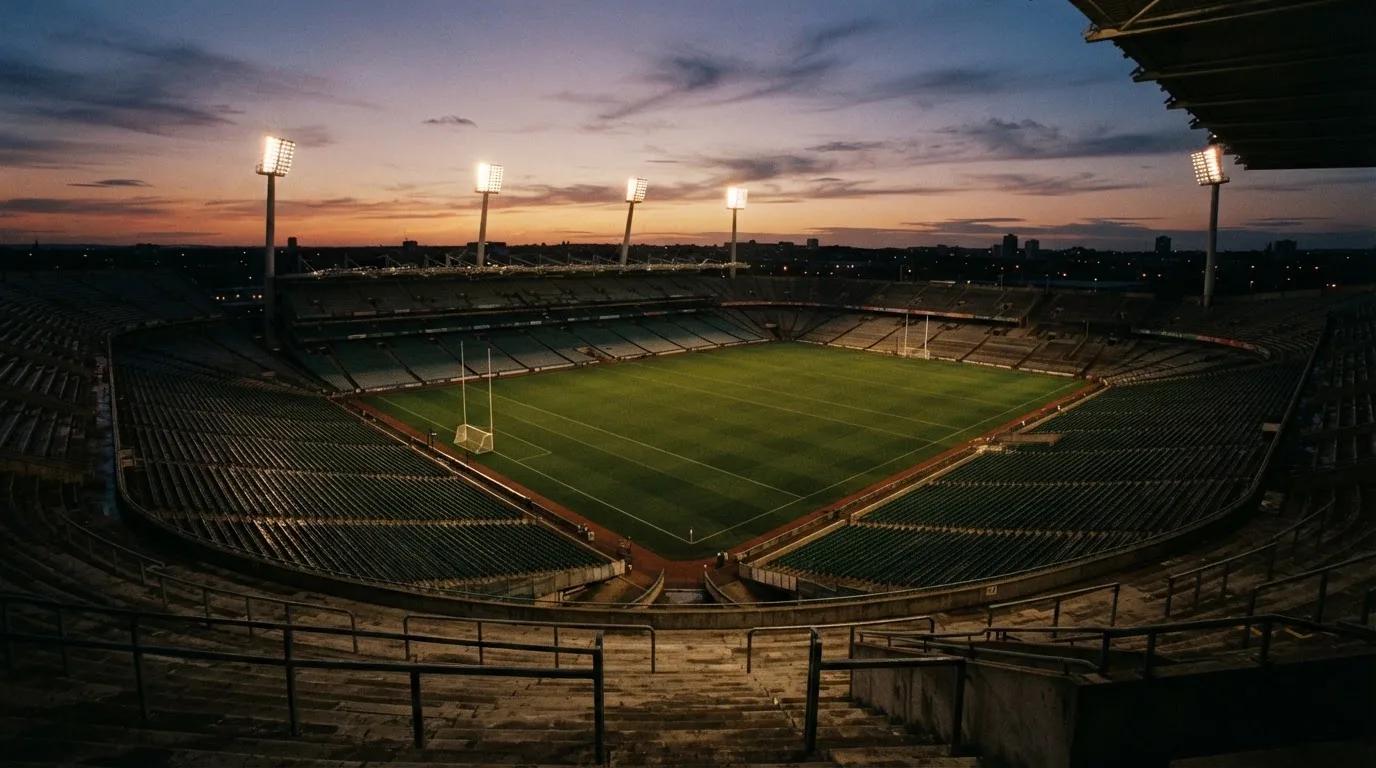
The fixture the punter actually meets is the All-Ireland Senior Football Championship, run by the Gaelic Athletic Association, whose final lands each year at Croke Park in Dublin. Kerry hold the record for most All-Ireland Senior Football Championship titles, with thirty-nine. The 2026 final was played on 26 July 2026 at Croke Park, with Mayo beating Kerry 1–20 to 1–17 to take their fourth title. UK-facing bookmakers carry that championship and the club championship underneath it; the National League, run earlier in the calendar, is also quoted. Beyond Ireland, club competitions in Britain and North America do exist, but no GB-facing operator carries them as a standing line.
The betting proposition, in plain words, is the same as for any other field sport: pick an outcome, agree a price, the bookmaker takes a cut of every pound staked. The differences are in the line. Gaelic football odds are quoted in fractional form by habit — 5/1, 11/4, evens — and decimal form in the app. Both say the same thing in two languages. A 5/1 fractional is a 6.00 decimal: stake one pound, return six if it wins, profit five. Evens, 1/1, is a 2.00 decimal. The odds-on end — anything shorter than evens — is where the bookmaker’s margin is most easily hidden, because the prices look close to “1.00 plus a bit” and a punter reads the “bit” rather than the cut.
Licences, Regulation and What a “Licensed Bookmaker” Means
Every operator reviewed on this page holds a remote operating licence from the Gambling Commission — a non-departmental public body that regulates commercial gambling in Great Britain under the Gambling Act 2005. Northern Ireland runs under its own older law, so the right phrase is “GB-licensed” or “Great Britain licence”, not “UK licence”. The Commission’s public register is the whole test of who holds one: it can be searched by business name, trading name, domain or account number. A licence number on an operator’s own homepage means nothing on its own; what matters is whether the same number turns up on the register, under the same legal entity. Where the brand on the shop window and the company on the licence are different — Ladbrokes and Coral both sit under LC International Limited, Paddy Power and Betfair both sit under PPB Counterparty Services Limited — the licence covers both, and a punter is dealing with one regulated business that happens to operate more than one front.

Since the Gambling (Licensing and Advertising) Act 2014, any operator whose remote facilities are used in Great Britain needs a Commission licence wherever it is based. A Curaçao, Maltese or Gibraltar licence is not a substitute; the test is the point of consumption. The categories that matter for sports betting are remote general betting standard (real events), remote general betting standard (virtual events), remote general betting limited, remote pool betting, and remote betting intermediary — the last being the licence a betting exchange runs under. None of those categories lists which sports or markets may be offered: there is no statutory list of permitted bets. An operator is licensed for a category, and what it puts under that licence is governed by its own house rules and the Licence Conditions and Codes of Practice.
Betting on Gaelic football at a GB-licensed bookmaker is not a question of “is this sport permitted” but of “does this operator have a market for it”. Most do, with the Championship and National League covered and the club championship underneath. A handful carry very little beyond the headline All-Ireland fixtures. The public register is the place to confirm what a given operator holds before opening an account; the home page is not.
Financial spread betting is regulated by the Financial Conduct Authority, not the Commission. Spreadex, for instance, is regulated by the FCA for spread betting and by the Gambling Commission for fixed-odds betting, and it states on its own homepage that spread-betting losses can exceed the deposit. That distinction — fixed odds on one side, FCA-regulated spread betting on the other — is not a marketing nicety; it is the line that decides whether a loss is capped at what they staked or whether it can run further.
Safer Gambling Tools That Come With the Licence
A GB-licensed remote operator is bound by the Commission’s social responsibility code, and the customer gets several safeguards the licence makes compulsory.
GAMSTOP is the national multi-operator self-exclusion scheme, mandatory for online operators since 31 March 2020. A self-exclusion can run for six months, one year, five years, or five years with auto-renewal. After the minimum period, the exclusion stays in place for a further seven years unless the customer asks GAMSTOP to remove it. GAMSTOP covers online sites and apps; high-street betting shops use a separate service, which is why an online self-exclusion does not, by itself, stop a shop visit.
Identity verification is compulsory before the first deposit or bet at a GB-licensed site, in force since 7 May 2019. Name, address and date of birth are checked; the check covers even free bets and bonuses, not only real-money play. There is no anonymous play on a licensed site. That is a real cost to anyone who values privacy and a real protection to anyone who values being treated fairly if something goes wrong.
Financial vulnerability checks — the Commission’s condition 3.4.4, in force since 30 August 2024 — apply once a customer’s deposits minus withdrawals cross £150 in a rolling 30-day period (since 28 February 2025). The check is a public-record search, looking for markers such as bankruptcy or county court judgments. It is not an income check and not a credit reference check. A wider “financial risk assessment” — what the press calls affordability checks — has been announced by the Commission in a staged plan, with no start date yet.
Deposit limits (RTS 12) are the customer’s tool. Operators must offer a gross deposit limit on a fixed time frame; the first phase has applied since 31 October 2025, a second phase was postponed to 30 September 2026, and whether it is live at the time of reading is not something to assume. There is no state-set cap on stakes or losses in sports betting: operators set their own maximum stakes and may restrict customers individually. Help is available through GamCare (the National Gambling Helpline), GambleAware, NHS gambling clinics and Gamblers Anonymous.
The credit-card ban for gambling in Great Britain has been in force since 14 April 2020 (LCCP condition 6.1.2). It covers credit-card-funded payments through an e-wallet, not only direct card spend. Debit cards and bank-based payments are not covered. Anyone whose only funding method is a credit card has hit a hard wall at the cashier.
The honest summary: licensed play means identity checks, deposit limits, GAMSTOP and the bonus cap below. Unlicensed play means none of those, and if funds are withheld there is no British route to complain. Neither is “the safe choice” by default; each is a trade-off the punter makes with eyes open.
Crypto, Anonymity and the Licensed Question
There is a slice of search interest in Gaelic football betting that runs through crypto and other pseudonymous funding. In Great Britain, that path is narrow. Crypto deposits are not banned at a licensed bookmaker, but no GB-licensed operator is known to promote them as a primary route. Identity verification before the first deposit makes anonymity impossible at the cashier of any operator on the Commission’s public register, regardless of how the deposit is funded. A crypto-funded deposit still has to be matched to a verified identity before a withdrawal is paid.
The punters who value anonymity above the protections of a GB licence do have alternatives: offshore sites licensed in Curaçao, Malta, Gibraltar or Anjouan will accept crypto without the same checks. The cost of that route is real. A GB licence is compulsory at the point of consumption; an offshore operator serving a customer in Great Britain without one is committing an offence under section 33 of the Gambling Act 2005. The offence is aimed at the operator, not at the customer, but the customer’s losses are uninsured: no GAMSTOP coverage, no Commission complaints route, no approved dispute-resolution body, no British consumer redress if funds are withheld, and the operator is not bound by the bonus cap or the vulnerability check. Enforcement runs through cease-and-desist notices, search-engine referrals, work with registrars, hosts and payment providers, and the court-order DNS blocking powers the Commission has been given or is about to receive. Honest framing: a licensed bookmaker is checked, limited, and known; an offshore bookmaker is unchecked, ungoverned, and on its own.
Bonuses and Free Bets — What They Cost
A bonus is a marketing word that often hides a cost. The Commission’s promotion rules, in force since 19 January 2026, cap wagering requirements on bonuses at 10x — meaning a £10 bonus at 50x wagering needed £500 of qualifying bets before the bonus and any winnings could be withdrawn, and under the cap no more than £100. The cap is on the operator, not on the punter, but the punter benefits when it binds. Mixed-product promotions — an offer that requires gambling on two or more product types such as betting plus casino, betting plus bingo, or betting plus lottery — are banned. Whether the cap applies to a free bet that carries no wagering condition, and any cap on the money value of a bonus, are not established.
A “free bet” usually does not return the stake. A £10 free bet at 5/1 returns £50, not £60, because the £10 stake is forfeit. That distinction sounds small on a single bet and adds up across an accumulator. The Bet Builder and acca insurance products that GB-licensed operators push on football — and that some extend to Gaelic games — work the same way: a refunded stake lands as a free bet with the same stake forfeit. The “risk-free” framing that an operator may put around a first bet is, in practice, a free-bet refund. “Enhanced odds” and “price boosts” raise the headline price but usually pay the boost in free bets, not cash, and the stake is still not returned. A cashback promotion pays back a slice of net losses as cash or bonus; the difference is whether the money can be withdrawn without further play.
The arithmetic of a free bet: for a free bet whose stake is not paid back, value = free-bet amount × (odds − 1) ÷ odds × payout share of that market. Plug a £10 free bet at 5/1 (a 6.00 decimal) into a market with a 95% payout share and the value is roughly £10 × 5 ÷ 6 × 0.95 = £7.92. The headline offer is “£10 free”, the spendable value is closer to £8. The same £10 at 1/2 (1.50 decimal) on the same market is worth about £10 × 0.5 ÷ 1.5 × 0.95 = £3.17 — a free bet at short odds is mostly a marketing ornament.
The cost of clearing a deposit bonus: required turnover = bonus base × wagering factor; bets needed = turnover ÷ stake per bet; only bets at or above the minimum price (the operator’s qualifying-odds floor) count. A £50 bonus at 5x wagering on £10 bets is £250 of qualifying turnover, or 25 bets at the qualifying price. The expected cost is roughly required turnover × margin of the market the bets are placed on. A 5% margin over £250 of turnover is £12.50 of expected drag — the price of unlocking the bonus, before any cap on winnings is applied.
The most expensive part of a bonus is usually the small print. Minimum odds, qualifying-market restrictions, expiry windows, payment-method exclusions (e-funds such as Skrill or Neteller often do not qualify), stake caps while the bonus is being cleared, and caps on free-bet winnings can each shave the headline back by half. A “100% bonus up to £100” that needs to be turned over 10x at minimum odds of 1.50 with a five-day expiry is a job of work, not a gift.
Live Betting and Cash Out on Gaelic Football
Live betting on Gaelic football is offered by most GB-licensed bookmakers that carry the sport. In-play on Gaelic football differs from in-play on Premier League football in two respects. Liquidity is thinner, so the price moves in bigger steps and the cash-out value swings more dramatically with each score. Markets are narrower: most operators carry the match result, the next score, the handicap and the total, and stop there. The bookmaker’s edge is the same in shape — the margin lives in every price — but the lower liquidity makes it harder to read where the public money has gone, and the prices tend to lag scores rather than lead them.
Cash out, where offered, lets the punter settle a bet before the final whistle at a price the operator sets. Auto cash-out, on the apps that carry it, lets the punter set a target and walk away. The cash-out price is set by the operator, not the market, and the gap between the cash-out price and the true price at that moment is the operator’s cut on the cash-out itself. That gap is widest in the moments after a score, when the bookmaker’s algorithm has not yet settled into the new state of the game, and at the end of a close match, when the operator’s risk team moves the price to manage liability. The honest way to use cash out is as a discipline tool — to lock a profit or cap a loss — rather than as a value play.
Bet Builder and same-game multi products are carried by most GB-licensed operators, and some extend them to Gaelic football fixtures. A Bet Builder combines markets from one event — for example, match result plus total points plus first goalscorer — into a single bet at combined odds. The catch is the correlation: the markets within a builder are correlated by the underlying game, and the operator’s margin applies to each leg before the prices are multiplied. The compounded margin on a five-leg builder is higher than the headline single-leg price suggests.
Predictions, Tips and the Limits of Strategy
Gaelic football betting tips and predictions are searched for as a category in their own right. The honest framing is short. Nobody can name the winner of a GAA fixture with certainty. Anybody who claims they can is selling something. Form, head-to-heads, home advantage, weather, and injuries are all real inputs, but they do not add up to a forecast; they add up to a bet at a price, with the bookmaker’s margin already taken out.
Bankroll management is the strategy that does not need a forecast. Set a unit size — a fraction of the bank, often 1% to 2% — and stick to it. Specialise: punters who follow a league closely find value in markets the casual market prices loosely, and Gaelic football is exactly that kind of league. Shop the line: the price on the same fixture varies across operators, and the gap is widest in lower-profile sports. Keep a record of bets, prices and outcomes: the price theory is the only way to know whether a tipster’s edge is real or whether the price theory has been wrong all along.
What tips and predictions cannot do is predict an outcome. They can sharpen the price a punter pays, and the price is the only edge a punter has.
Bet Types, Markets and How Odds Are Built
The bet types offered on Gaelic football at a GB-licensed bookmaker run along familiar lines. Singles, doubles, trebles and accumulators — “accas” in the app — are the spine. Each-way bets, more common in horse racing, appear on outright markets such as the All-Ireland Senior Football Championship winner. Bet Builder combines markets from one event. Spread betting on Gaelic football is offered by the operator licensed for it and runs on a different spread bet of the score, with losses that can exceed the deposit — the FCA-regulated corner of the market.
The odds are built from the bookmaker’s margin. The margin is the share of every pound staked that the operator keeps on average across a market, irrespective of which outcome wins. The mechanical way to see it: for a market with prices p₁, p₂, …, pₙ on every outcome, the payout share is 1 ÷ (1/p₁ + … + 1/pₙ) and the margin is 1 minus the payout share. A two-way market priced at 1.90 / 1.90 has a payout share of 1 ÷ (1/1.90 + 1/1.90) = 0.95, a margin of 5%. The same market at 1.85 / 1.85 has a payout share of about 0.925, a margin of about 7.5%. Same selection, same fixture — the punter pays 2.5 pence more per pound staked at 1.85 than at 1.90.
The margin is the cost the punter pays for the privilege of having a bet. A 5% margin on a £100 turnover over a season costs £5 in expected drag; a 10% margin costs £10. Liquidity is the second cost. A market with few bets behind it prices less efficiently, and the gap between the true price and the offered price is wider than on a liquid Premier League market. Gaelic football sits on the less-liquid side of that line for most UK-facing operators.
The conversion between fractional and decimal odds is the small bridge every punter crosses several times a day. A fractional a/b is a decimal a ÷ b + 1: 5/1 is 5 + 1 = 6.00, 11/4 is 11 ÷ 4 + 1 = 3.75, evens (1/1) is 2.00. Odds-on — anything shorter than evens — sits between 1.01 and 2.00. The bookmaker’s favourite on a Gaelic football match often lands at 4/6 or 1/2 in fractional, 1.67 or 1.50 in decimal; the outsider in a one-sided fixture goes past 10/1, a 11.00 decimal. The same odds are quoted two ways because two generations of punters learnt them differently.
The Sports, the Fixtures and the Market
Gaelic games are the family: Gaelic football and hurling, the two field sports run by the GAA. Hurling is the stick-and-ball sibling, played on the same pitch shape with different skills and a different scoring profile; the betting proposition is the same in shape. Most UK-facing bookmakers treat them as one coverage shelf: search “Gaelic football”, search “hurling”, and the operator’s site returns the same championship section.
The fixture list a UK punter actually bets on is the All-Ireland Senior Football Championship, the All-Ireland Senior Hurling Championship, the National League, the club championships underneath, and a smaller set of inter-provincial fixtures. The Championship runs through the summer and finishes at Croke Park; the National League runs through the late winter and early spring; the club championship is the autumn. The All-Ireland final this year sat in late July — the 2026 final on 26 July — and the Club Championship closes the calendar in early spring the following year.
The bookmaker’s calendar of markets runs on the same fixture list. Outright winner markets open months ahead of the championship; match markets open closer to the day; in-play markets open with the throw-in. The headline markets at the GB-licensed operators are match result, handicap, next scoring play, total points, first goalscorer, and player performance markets on the bigger fixtures. The size of the market on a Division 1 league fixture is a fraction of the size on an All-Ireland final; the size of the price theory around the margin is, again, a fraction.
A note on what is not on the page: novelty markets, politics, esports — all offered at GB-licensed bookmakers under various licence categories, none of them relevant to the GAA fixture list. Esports is a separate licence area in any case.
The Ten Licensed Bookmakers — What Each One Costs
What follows is the comparison of ten GB-licensed operators that carry Gaelic football lines. Each review runs through what the licence looks like, what the welcome offer costs in real terms, what the in-play and cash-out product looks like, and the verdict that distinguishes one from the next. No one bookmaker is “the only” licensed one; the place in the ranking is a comparison, not a licence. Every brand below sits on the Gambling Commission’s public register under the licence number named, and every offer is described only as each operator’s own terms state it.
The comparison table that follows shows the licence number and licence holder alongside a short note on what each operator’s own terms state on the key’s subject.
| Brand | Gambling Commission remote licence and holder | What the operator’s own terms state |
|---|---|---|
| Ladbrokes | 054743-R-330863-014, LC International Limited | Long-running fixed-odds book with a deep in-play product and a sports app rated 4.66 from 101,255 ratings in the GB App Store |
| Paddy Power | 039439-R-319330-013, PPB Counterparty Services Limited | Sports app covers football, horse racing, boxing, rugby, tennis, golf, darts, snooker and F1, with Gaelic games on the football shelf |
| DAZN Bet | 048756-R-327274-019, DZBT Limited | Deposits start at £5 by debit card, Apple Pay, Paysafecard, Trustly and Skrill, and at £20 by PayPal, with no processing fees |
| BetUK | 039198-R-319450-029, LeoVegas Gaming PLC | Sports welcome: deposit £10 or more, place a sports bet within 7 days, receive four £10 free bets (two football accas of 4+ and two multiples of 2+), valid 7 days, opt-in required |
| Sporting Index | 027343-R-308898-011, Sporting Index Limited | Switch between fixed odds and spread betting, in-play, Bet Builder for football, auto cash-out, Multi-Markets |
| BoyleSports | 039469-R-319383-025, Boylesports Enterprise | Sports welcome for UK players: £20 in free bets when a £10 bet is placed (£30 in free bets for a €10 bet for Irish players) |
| Lottoland | 038991-R-319408-020, EU Lotto Limited | Casino, lottery betting, sports betting and scratchcards in one UK app; licensed by the Gambling Commission for customers in Great Britain |
| Octobet | 062545-R-337248-006, Octopus Game Limited | Sports welcome: 50% back as a free bet up to £50, plus a £10 casino bonus for new customers |
| Kwiff | 044448-R-323408-017, Eaton Gate Gaming Limited | Licensed by the UK Gambling Commission; the trademark is operated by Spryme Ltd; the app carries a 17+ App Store age rating |
| Betboro | 044181-R-324363-007, Webmedia Development N.V. | Sports welcome: 100% matched free bet of up to £25 on the first qualifying wager, requiring a debit-card deposit of at least £10 and a first bet of £5 to £25 with at least three selections each at 3/5 (1.60) or higher |
Ladbrokes — the established spread
Ladbrokes’ licence is the Commission’s 054743-R-330863-014 under LC International Limited, and the same licensee covers Coral. The brand carries the All-Ireland Senior Football Championship and the National League outright, match markets on most fixtures, in-play with cash-out, and a Bet Builder on the headline fixtures. The sports app is rated 4.66 from 101,255 ratings in the GB App Store, published by Entain Operations Limited — that rating is the punter’s read on a long history rather than a forecast of the price. Ladbrokes is the operator the casual punter reaches first, and the depth of market is real.
The verdict: Ladbrokes costs the punter what every long-established bookmaker costs — a market margin of around 5% on the headline football markets and a wider one on Gaelic fixtures — but the depth of coverage and the liquidity of the in-play product justify that cost for the punter who wants the whole price ladder in one app. For the punter chasing a half-point tighter line, the comparison below holds better choices.
Paddy Power — the full-card book
Paddy Power’s licence is the Commission’s 039439-R-319330-013 under PPB Counterparty Services Limited, the same licensee that runs Betfair. The brand is a sportsbook-plus-exchange operation: Paddy Power covers football, horse racing, boxing, rugby, tennis, golf, darts, snooker and F1 from a single sports betting app published by Paddy Power PLC. Gaelic games sit on the football shelf, with the All-Ireland Championship outright, match markets and in-play. The exchange layer sits underneath for the punter who wants to lay rather than back.
The verdict: Paddy Power costs roughly the same as Ladbrokes on the headline markets, and the exchange product on the bigger fixtures is the differentiator. The punter who wants to back and lay the same Championship fixture pays for both in one app. The punter who only wants to back pays for the exchange layer they are not using.
DAZN Bet — the small-deposit route
DAZN Bet’s licence is the Commission’s 048756-R-327274-019 under DZBT Limited. The minimum deposit is the differentiator: £5 by debit card, Apple Pay, Paysafecard, Trustly or Skrill, and £20 by PayPal, with no processing fees. The same minimum does not always carry to the stake: the operator sets its own maximum-stake caps per market and may restrict customers individually. Gaelic football is covered on the football shelf, with the championship outright and match markets.
The verdict: DAZN Bet costs the same in margin as the bigger books on Gaelic football, but the £5 floor on the most common payment methods makes it the cheapest entry point for the punter who wants to test the market with the smallest stake. The PayPal floor at £20 is the figure to remember.
BetUK — the free-bet ladder
BetUK’s licence is the Commission’s 039198-R-319450-029 under LeoVegas Gaming PLC. The sports welcome offer is the differentiator on the page, and it is the place the small print does the most work. The headline: deposit £10 or more, place a sports bet within 7 days, receive four £10 free bets — two football accumulators of four or more selections and two multiples of two or more — valid for 7 days, with opt-in required. The four free bets are worth roughly £10 × (odds − 1) ÷ odds × payout share each, so on a 95% market the headline £40 is closer to £32 of value. The stake is forfeit on every free bet; the seven-day window is short; the qualifying bet on the account is at the customer’s own stake; and the four bets are pre-split into accas and multiples rather than left to the customer to choose.
The verdict: BetUK costs the punter the qualifying bet to begin with and roughly £8 in forfeited stake across the four free bets at typical Championship prices. For the punter who would have placed the qualifying bet anyway, that is a real £32 of value on a £40 headline. For the punter placing a qualifying bet only to chase the free bets, the maths is closer to break-even. The seven-day expiry on the free bets is the part to read first.
Sporting Index — the spread bet alongside the fixed-odds book
Sporting Index’s licence is the Commission’s 027343-R-308898-011 under Sporting Index Limited. The product is different in shape: fixed odds and spread betting under one roof, with in-play, Bet Builder for football, auto cash-out and Multi-Markets. The spread-betting side carries the FCA-regulated caveat that losses can exceed the deposit — the same caveat that applies to Spreadex. Gaelic football is covered on the fixed-odds side; spread bets on GAA fixtures are a narrower offer.
The verdict: Sporting Index costs the punter the standard fixed-odds margin on the standard markets and a wider spread-betting cost on the spread side, with the FCA-regulated caveat that losses can run beyond the deposit. For the punter who wants to combine a fixed-odds Championship bet with a spread bet on the total points, this is the only book on the page that does both. For the punter who wants fixed odds only, other operators on this list provide a more straightforward pricing structure.
BoyleSports — the cross-jurisdiction welcome
BoyleSports’ licence is the Commission’s 039469-R-319383-025 under Boylesports Enterprise. The sports welcome offer is structured by jurisdiction: £20 in free bets for UK players when a £10 bet is placed, €30 in free bets for Irish players when a €10 bet is placed. The Irish price is higher in headline terms because the Irish market is the home market — BoyleSports grew out of Irish betting shops and the Irish punter is the target. The UK punter gets the smaller of the two. Gaelic games are the home sport, with the All-Ireland Championship covered in depth and the club championship underneath.
The verdict: BoyleSports costs the UK punter a slightly thinner free-bet ladder than the Irish headline, and the Championship coverage is the deepest on the page because it is the home sport. For the UK punter who bets Gaelic football as a primary interest rather than a side bet, BoyleSports is the most complete single book on the page.
Lottoland — the multi-product app
Lottoland’s licence is the Commission’s 038991-R-319408-020 under EU Lotto Limited. The product is unusual on this page: casino, lottery betting, sports betting and scratchcards in one UK app, licensed by the Gambling Commission for customers in Great Britain. Sports betting is the smaller slice of the business model; lottery products are the larger one. Gaelic football is on the sports shelf with the Championship outright and the headline match markets.
The verdict: Lottoland costs the punter a sportsbook margin on a sportsbook that is one product among four. The Championship coverage is functional rather than deep. For the punter who already plays the lottery side and wants sports betting in the same wallet, this is the route. For the punter who only wants sports betting, this is likely not the first port of call.
Octobet — the half-back welcome
Octobet’s licence is the Commission’s 062545-R-337248-006 under Octopus Game Limited. The sports welcome is 50% back as a free bet up to £50, plus a £10 casino bonus for new customers. The 50% back reads as half the headline of a 100% bonus; the practical difference is that the qualifying stake on the account is the amount the punter is comfortable staking, and the refund is capped at £50, not at the size of the first deposit. A £100 first bet that loses returns £50 as a free bet, where a 100% bonus would have given £100 of bonus tied to turnover.
The verdict: Octobet costs the punter the qualifying stake and roughly half the headline as a free bet that does not return its stake. For the punter who wants to back a Championship outsider and would have taken the price anyway, this is the cleaner small-print shape on the page. The £10 casino bonus is a separate offer with its own small print.
Kwiff — the trademark route
Kwiff’s licence is the Commission’s 044448-R-323408-017 under Eaton Gate Gaming Limited. The site describes itself as a trademark operated by Spryme Ltd, and the app carries a 17+ App Store age rating. Gaelic football is covered on the football shelf. The brand’s marketing leans on “supercharged” prices and surprise boosts; the price mechanism is the same as every other bookmaker — the margin lives inside every price — and the boosts are paid as free bets with the stake forfeit.
The verdict: Kwiff costs the punter the standard sportsbook margin on the standard markets, plus the price of treating every boost as a free bet at a stake that is forfeit. For the punter who likes a surprise price, Kwiff is the route. For the punter who values a consistent and predictable line on the Championship, it may be worth exploring other options.
Betboro — the matched free bet
Betboro’s licence is the Commission’s 044181-R-324363-007 under Webmedia Development N.V. The sports welcome is a 100% matched free bet of up to £25 on the first qualifying wager, requiring a debit-card deposit of at least £10 and a first bet of £5 to £25 with at least three selections each at 3/5 (1.60) or higher. The three-selection minimum and the 1.60 floor are the parts to read. A first bet on a Championship outright at 5/1 does not qualify; a first bet on a Championship match result plus total points plus first goalscorer at combined odds of 1.60 or higher does.
The verdict: Betboro costs the punter a qualifying first bet structured as a treble or bigger, with the refund as a free bet whose stake is forfeit. For the punter who would have placed the qualifying bet anyway at three selections or more, the headline matches the deposit up to £25. For the punter placing a single to chase the bonus, the bet does not qualify.
The Cost in Numbers — A Worked Example
The arithmetic that matters is the margin. A two-way market priced at 1.90 / 1.90 (a 9/10 fractional on each side) has a payout share of 1 ÷ (1/1.90 + 1/1.90) = 0.95 and a margin of 5%. The same selection at 1.85 / 1.85 has a payout share of about 0.925, a margin of about 7.5%. The band on Gaelic football match-result markets at GB-licensed operators runs roughly 5% on the headline Championship fixtures to 8% and beyond on the club championship underneath, depending on the operator and how close to the throw-in the price is set. State it as a band with the condition, because a single number is dishonest: liquidity, fixture, time-to-off and operator vary, and the cost varies with them.
The cost of clearing a £50 bonus at 5x wagering on £10 bets at a 6% margin over the bonus lifetime: required turnover £250; expected drag £250 × 0.06 = £15. The bonus headline of £50 is closer to £35 once the cost of clearing is taken off. A £25 matched free bet at 5/1 on a market with a 95% payout share is worth about £25 × 5 ÷ 6 × 0.95 = £19.79 — the headline of £25 is closer to £20 of value, with the £5 difference being the stake forfeit. The same £25 free bet at 1/2 on the same market is worth about £25 × 0.5 ÷ 1.5 × 0.95 = £7.92 — a free bet at short odds is mostly a marketing ornament.
What the Comparison Carries
The honest summary of ten licensed operators on Gaelic football lines runs along three axes: the depth of the Championship and league coverage, the small print of the welcome offer, and the floor on the deposit and stake. BoyleSports leads on coverage because the sport is its home market. DAZN Bet leads on the deposit floor at £5 for the common payment methods. BetUK leads on the headline value of the welcome ladder, with the four free bets split into accas and multiples. Betboro leads on the structure of a single matched free bet for the punter who would have placed a treble anyway. Ladbrokes, Paddy Power and Sporting Index lead on the depth of the in-play and Bet Builder product. Lottoland, Octobet and Kwiff sit in the second tier on this sport, each with a differentiator that does not depend on Gaelic football.
The cost the punter pays in any of them is the margin inside the odds plus the forfeit on free-bet stakes plus the qualifying stake on bonus offers plus the time-cost of meeting turnover. None of those numbers is small. None of them is hidden. The point of comparing ten licensed books is not to find one without a cost; it is to find the cost that fits the punter’s bankroll and the punter’s tolerance for small print.
Frequently Asked Questions
How is a bet placed on Gaelic football?
Open an account with a GB-licensed bookmaker, complete identity verification, deposit by debit card or another accepted method, and pick a market on the All-Ireland Senior Football Championship, the National League or the club championship. The minimum stake is set by the operator; on some books the deposit floor is as low as £5. The minimum age is 18.
How can it be checked that a bookmaker holds a Gambling Commission licence?
Search the Commission’s public register by business name, trading name, domain or account number. The licence on the home page is the starting point; the register is the test. Where the brand on the shop window and the legal entity on the register are different names, the licence covers both. A licence number alone, off the register, is not proof.
How is the return on a bet worked out from the stake and the odds?
For a single bet, return = stake × odds. Net profit = stake × (odds − 1). For a combination bet, the odds of the legs multiply into one price. A £10 stake at 6.00 (5/1 fractional) is a £60 return and a £50 profit.
What is the bookmaker’s margin and how can it be seen in the odds?
The margin is the share of every pound staked that the bookmaker keeps on average. For a market with prices p₁ … pₙ on every outcome, payout share = 1 ÷ (1/p₁ + … + 1/pₙ) and margin = 1 − payout share. A market at 1.90 / 1.90 has a 95% payout share and a 5% margin. A market at 1.85 / 1.85 has roughly a 92.5% payout share and a 7.5% margin.
How do fractional odds such as 5/1 convert to decimal odds such as 6.00?
A fractional a/b is a decimal a ÷ b + 1. 5/1 is 5 + 1 = 6.00; 11/4 is 11 ÷ 4 + 1 = 3.75; evens (1/1) is 2.00. Odds-on (anything shorter than evens) sits between 1.01 and 2.00. The two forms say the same thing in two languages.
Which tools for controlling play does a licensed bookmaker have to offer?
GAMSTOP for multi-operator self-exclusion; deposit limits set by the customer on a fixed time frame; timeouts and self-exclusion at the operator; financial vulnerability checks once deposits minus withdrawals exceed £150 in a rolling 30 days. Help is available through GamCare, GambleAware, NHS gambling clinics and Gamblers Anonymous.
Rugby, cricket & Gaelic – Lowdepositbetting.com
Content created by the «Lowdepositbetting.com» team
