
Chess betting odds in Great Britain for 2026: prices, markets and the cost the punter pays
 Available in US
October 30, 2026 · current against the Gambling Commission’s public register
A chess betting market behaves no differently from any other two-outcome or three-outcome sporting market. The bookmaker sets two prices (win and lose, with draw priced as a third outcome when it can occur) and takes a margin — a built-in cut — out of them before the bet is ever struck. How big that cut is, where the price is set, and what extra rules the operator bolts onto a Chess bet are the three questions this page answers for British punters who want to back a World Championship cycle, a Candidates match or a quicker online game.

The angle here is cost. A £10 bet at 2.50 returns £25 if it lands; a £10 accumulator at a combined 12.00 returns £120. None of that is the punter’s profit, because the price is not the offer. The price is the offer minus the bookmaker’s margin, and the page that follows is built around making that margin visible — at the betting slip, on the outright board and across the differences between ten Gambling Commission-licensed bookmakers that take bets on Chess.
Chess and the betting landscape in Great Britain
Chess sits alongside any other sport on the betting slips of British bookmakers. There is no statutory list of permitted sports: the Gambling Commission’s licensing regime covers the bookmaker, not the sport it offers, and an operator with a remote general betting standard (real events) licence may carry a chess market if it judges the demand. That is why every operator on this page lists Chess among its sports, usually under eSports or a special-interest filter, alongside the football, horse racing and tennis the same bookmaker covers as a matter of course.
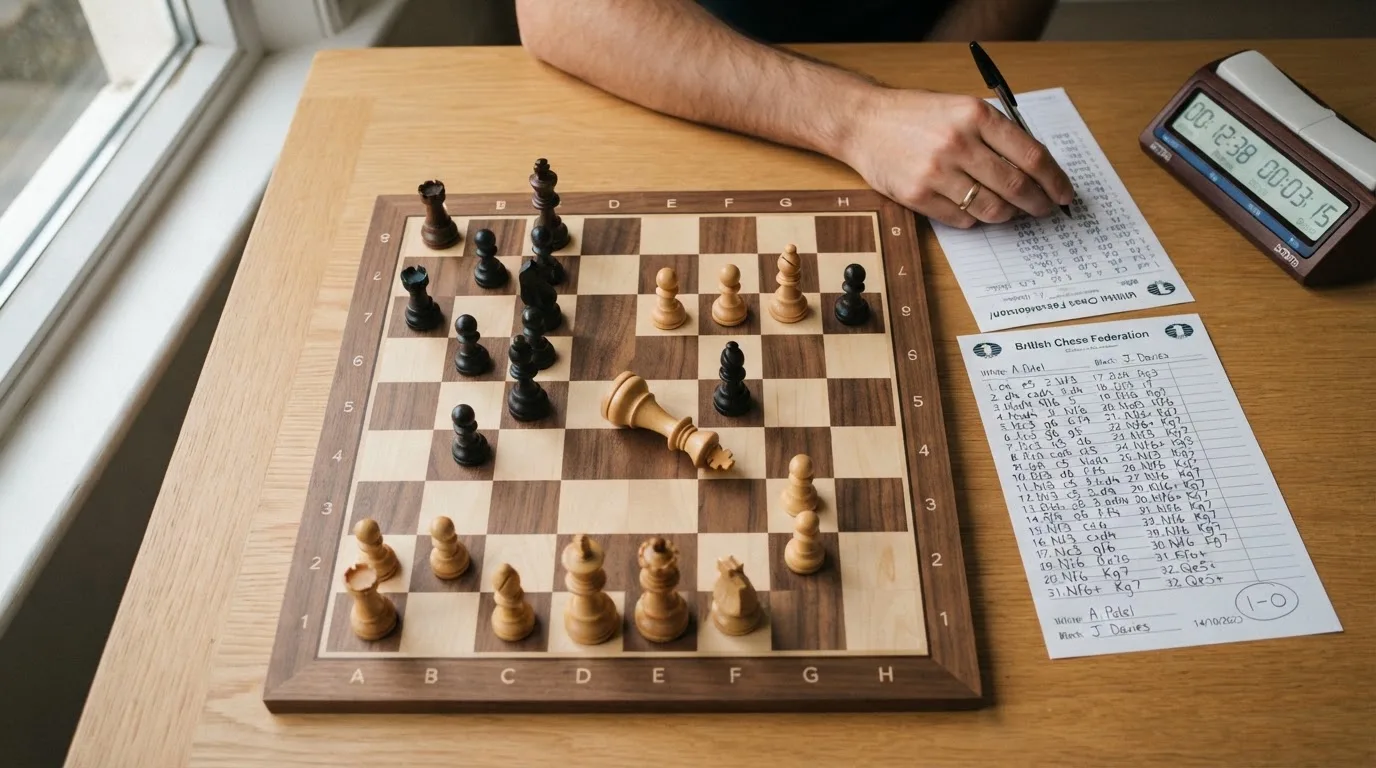
The calendar reflects the game itself. Most chess betting sits around FIDE’s competitive structure: the World Chess Championship cycle, the Candidates Tournament that decides the challenger, the Grand Prix series, club events such as the PRO Chess League and online events with shorter clocks. Each one settles under FIDE rules — drawn by stalemate, by agreement, by threefold repetition or under the fifty-move rule — and most British bookmakers price matches as 1 (White win), 2 (Black win) and X (draw) using the standard chess result notation of 1–0, 0–1 and ½–½.
Bettors read a chess market the same way they read any other sport. The board is small, the season is short, and the price moves when a known player turns up at a smaller event — a fact the rest of this page takes for granted.
How odds and prices are set in Chess markets
A decimal price encodes exactly what it encodes on every other sport. Multiply the stake by the odds to get the gross return; subtract the stake to get the profit. A £10 single at 3.00 pays £30, with £20 of profit if the selection wins. A £5 accumulator at 12.00 (legs of 1.50, 2.00 and 4.00, say) pays £60, with £55 of profit. The shape is no harder than reading a football price, and the punter who can read a football price can read a chess one.
What changes the price — and what punter after punter on every sport mistakes for the offer — is the margin. A bookmaker’s margin is the percentage of every £1 staked that the bookmaker keeps on average, regardless of the outcome. It is built into the prices on both sides of a market, and it is the reason a “fair” two-way market at 50/50 would price 2.00/2.00 and a real two-way market at the same probabilities prices 1.90/1.90. The £0.10 off each pound is the margin, and on a Chess match between two evenly matched opponents it is the only thing the punter pays for the privilege of having a bookmaker take the bet.
Where the game offers only two outcomes (a win or a loss), the two prices straddle 2.00 in normal circumstances — a match between title-calibre players with a low draw frequency. Where the game can be drawn — most elite matches in classical chess, where drawn games are common — the bookmaker adds a third column and the maths shifts to a three-outcome market. The same rule applies in a football 1X2 market: three possible outcomes, three prices, and the margin applies to the book of all three together.
The arithmetic in this page is a worked example at 1.90/1.90, not a price a reader should expect to see in a real market. The order shows where the margin sits in two-outcome markets and how the figure changes the punter’s return; it is the framework that lets the punter read any concrete Chess price once one is in front of them.
The formula is straightforward. The first step is the sum of the implied probabilities — one over each decimal price, added together. For 1.90 and 1.90 the implied probabilities are 1/1.90 plus 1/1.90, which is 0.5263 plus 0.5263, equal to 1.0526. The payout share is the inverse: 1 ÷ 1.0526, equal to 0.95. The margin is 1 minus the payout share, or roughly 5% on a typical two-way Chess market.
What this means in pounds is a worked example with £20 of total stake and the £10/£10 split across both outcomes. With a 5% margin, the bookmaker keeps £1 and pays back £19 across every £20 staked on this market, averaged over the long run. On a real two-way event priced competitively — a World Championship game between two GMs priced around 1.85/2.20 — the margin falls in the same neighbourhood, often 4–7%. On a three-way game with the draw priced around 3.20 to 4.00, the margin typically settles 5–10%, the wider band reflecting the extra outcome the bookmaker has to price without knowing what will happen.
What the margin looks like in real markets
Two out of three chess markets carry a thin margin because the volumes are thin. Punters betting on an elite chess match are dealing with a market ten bookmakers quote rather than hundreds — and a thin market is rarely the most generous one. Each bookmaker sets its own margin, and it widens further on outright markets (Winner of the World Chess Championship, Name the Finalist, To Win the Candidates) than on individual matches. Outrights are settled over weeks or months, and the bookmaker’s exposure grows with the duration of the bet — which is paid for, indirectly, through tighter prices.
The same rule holds across sport. Football 1X2 margins sit in low single digits on the big leagues and climb into double digits on lower divisions or outrights. Tennis match-winner margins are often under 5%. Cricket markets in the major Test venues are usually thinner than the same bookmaker’s outright on the IPL winner. Chess follows that template and does not improve on it.
Two practical consequences. First, a punter who can identify which bookmaker runs the thinnest margin on a particular chess market saves real money on the same selection. Second, the price a punter actually pays is rarely the headline price an operator advertises — headline prices on an enhanced-odds offer routinely price the market above 100% implied probability and pocket extra margin. Both consequences are revisited in the offer section below.
Bet types offered on Chess matches
The smallest chess market is the match-winner line: a price on White, a price on Black and — when the format allows a draw — a price on the draw. Most elite matches do allow a draw, so the 1X2 line is the standard market for classical play. Rapid and blitz formats at top level also tend to allow a draw in classical play and produce decisive games more often in the shorter clocks, but the line is set by the operator’s house rule. Each bookmaker publishes which markets it will offer on each event, and a punter who wants to back an underdog should check the operator’s own match listing rather than rely on the tennis equivalent.
Outrights are the next set. The market that runs all year until a result is the Next World Chess Champion — a candidate by candidate price on who will hold the title at the end of the cycle. The Candidates Tournament generates its own book with a price on each participant and a price on the field. Lower-tier events are still priced but the depth of board collapses; a single Norwegian tournament may have a head price (winner), a place price (top 4) and a name-the-winner price for an obvious favourite, with little underneath.
Series and match handicap markets follow when the bookmaker has the data. A series handicap is a line on the score of a multi-game match — White −0.5, Black +0.5, draw no bet — built on a particular match-up. Total games (over/under a number of games in the match) is another standard market on any multi-game event in any sport.
In-game markets on chess are rare in the British market. Live betting requires a market the operator can update by the second, and chess does not fit that model cleanly — a single move can flip the engine evaluation of a position by a tenth of a pawn without producing a bettor-friendly event to hang a market on. The bookmakers who offer it do so as a result-line after each significant move, usually only on the most prominent events. Most punters who want to bet live on chess bet pre-match.
Combination bets — doubles, trebles, accumulators — operate exactly as in any other sport, with the prices of the legs multiplied together into a single price. The bet builder offered by most modern bookmakers works the same way on tennis or football: the operator combines markets from one event (a player to win, the number of games, the result after a particular move) into a single price. A £5 acca on three Chess match-winner selections at 1.80, 2.10 and 2.50 pays 1.80 × 2.10 × 2.50 = 9.45 times the stake, or £47.25 if all three land.
The price in a combination bet is never the sum of fair prices. Each leg carries its own margin, and the combined margin on a multi-leg bet sits above the margin on any single leg. Three legs at 5% each, combined, give a margin closer to 10%. That is a built-in drag on the punter’s expected return, and the rule “fewer legs beats longer legs” reads as true in chess as in every other sport.
Spread betting on Chess
A separate market exists under the financial spread betting model regulated by the Financial Conduct Authority rather than the Gambling Commission. Spreadex, for example, offers spread bets on sporting indices, which can include chess. The mechanics are not those of a fixed-odds bet: a spread is set, the punter’s stake is multiplied by the number of points the result moves by, and losses can exceed the stake. A £100 stake on White to win at a spread of 0–3 pays nothing for a White win by less than the high end of the spread, pays a £100-per-point profit as the index rises above 3, and pays a per-point loss against the punter if Black wins by any margin. The model is built for traders rather than casual punters and the FCA’s regulatory role sits beside the Gambling Commission’s role for fixed-odds betting only — Spreadex, for instance, is regulated by both bodies. Anyone new to spread betting on chess should treat the £100 stake as a worst-case figure, not a typical one.
The statutes behind a Chess bet in Great Britain
A Chess bet struck with a British bookmaker is governed by the Gambling Act 2005, which sets the licensing regime for commercial gambling in Great Britain. The Gambling Commission is the regulator; its public register lists every business that holds a Commission licence, and that register is the only test of who is licensed to take bets from a British address. A licence to take bets remotely — a remote general betting standard licence — entitles the holder to bet on Chess the same way it entitles the holder to bet on football.

Since 2014, an operator whose remote facilities are used in Britain must hold a Commission licence no matter where it is based. A Curaçao, Maltese or Gibraltar licence is not a substitute. The registered business operates the betting site, and that company’s licence is the licence the punter should look up on the Commission’s register before depositing.
Providing gambling facilities to customers in Britain without the required licence is an offence under section 33 of the Gambling Act 2005, aimed at the operator. No offence aimed at a customer betting with such an operator was found in the statutes, but the practical consequence for an unlicensed operator’s customer is the loss of every protection the licence brings: no GAMSTOP coverage, no Commission complaints route, no approved dispute resolution, and no British consumer redress if funds are withheld. Any operator that takes bets from a British customer without a Commission licence is operating illegally, regardless of where its servers sit.
There is no minimum stake in British law and no state-set maximum stake. Operators set their own minimum and maximum stakes and may restrict individual customers. The bet itself may be on virtually any event; the Gambling Commission’s regime lists categories of licence rather than categories of permitted bet, and chess sits under the catch-all “general betting standard (real events)” category alongside every other sport.
The age rule is hard. No one under 18 may bet, and the operator verifies name, address and date of birth before the first deposit and before the first bet — a rule in force since May 2019 that applies to a bet placed with a free bet or bonus as well as to one placed with cash.
Northern Ireland sits outside the Gambling Act 2005 and has its own older framework, so a “Great Britain licence” is the right phrase where the territory matters.
What the punter’s protection looks like under a GB licence
GAMSTOP is the national self-exclusion scheme: a single registration excludes the customer from every GB-licensed online operator. Periods run six months, one year, five years, or five years with auto-renewal, and after the minimum the exclusion stays in place for a further seven years unless the customer contacts GAMSTOP to lift it. GAMSTOP membership is a licence condition for online operators since March 2020 — every GB-licensed brand on this page has the GAMSTOP logo in its footer. Offline betting shops use a separate service and are not enrolled in GAMSTOP.
The financial vulnerability check (LCCP condition 3.4.4, in force since 30 August 2024) runs on licensed remote betting when a customer’s deposits-minus-withdrawals exceed £150 across a rolling 30 days. The check is a public-record check (bankruptcy, county court judgments), not an income check or a credit reference check, and it is run by the operator against identity data the customer has already supplied. The check returns no figure for most customers; where it flags something, the operator follows the LCCP guidance. Further affordability-style checks (financial risk assessments) have been announced by the Commission in a staged plan from July 2026, with no start date — when writing, treat them as a future measure, not a current one.
Deposit-limit rules changed in two phases. The first changes applied from 31 October 2025; a second phase was postponed to 30 September 2026 and whether it is now live is unestablished. There is no state-set ceiling on the size of any deposit or any bet; limits are the customer’s choice. An operator must offer a deposit limit on a fixed time frame, but the limit itself is set by the customer.
The marketing the punter sees is governed by advertising codes, not the Commission’s licence conditions. The CAP Code (non-broadcast) and BCAP Code (broadcast), enforced by the ASA, run alongside LCCP marketing conditions. CAP Code section 16 requires marketing to be socially responsible, not to appeal strongly to under-18s and not to feature anyone who is or appears to be under 25 — a rule about who appears in adverts, not about who may bet.
Promotion-specific rules have applied since 19 January 2026. Wagering requirements on bonuses are capped at 10× (a £10 bonus at 50× would have cost £500 of qualifying bets; under the cap, no bonus may require more than £100 of qualifying bets for the same £10 issue). Mixed-product promotions — an offer that requires gambling on two or more product types in one bundle — are banned. Whether the 10× cap applies to free bets with no wagering condition, and any cap on the money value of a bonus, is unclear. The “whistle-to-whistle” rule (no betting ads five minutes before or after a live sporting event on TV, pre-watershed) is industry-led and not law. Premier League shirt-sponsorship withdrawals from the 2026/27 season onward are voluntary.
No gambling winnings tax falls on the British punter. General Betting Duty is the operator’s tax on gross profits, currently 15%; from 1 April 2027 a new remote betting rate of 25% applies within it for bets placed remotely, while remote bets on UK horse racing, self-service betting terminals in licensed premises, pool betting and in-person betting stay at 15% (HM Government policy paper of 26 November 2025). Until 1 April 2027 the remote rate stays at 15%, and whether operators pass duty on through the odds is not established. The Commission’s statutory levy is a separate charge and not a tax.
Help and self-exclusion beyond the betting site
GamCare runs the National Gambling Helpline — a free, confidential service by phone and online — and is the first port of call for a punter worried about their betting. GambleAware funds treatment and research and is not a helpline itself. NHS gambling clinics operate across the regions for higher-risk gambling problems. Gamblers Anonymous runs peer-led meetings across the country.
The operator’s own safer-gambling tools — deposit limits, timeouts, time-on-site reminders, self-exclusion at the brand level, link-through to GAMSTOP — are part of the licence, not an optional extra. The punter who wants a budget cap sets one themselves in the cashier before the first deposit, not after losses start to hurt.
A financial vulnerability check applies once the spending crosses the threshold described above. Where the check flags something, the operator contacts the punter for a conversation. The check itself is not a refusal to take a bet — it is a check.
What an unlicensed site costs the punter
Unlicensed operators operating for a British customer carry no Commission licence, no GAMSTOP enrolment, no advertising-code oversight, no LCCP marketing conditions, no affordability check, no bonus cap and no approved dispute resolution. A dispute over a withdrawn payout at an unlicensed brand has no British route to settle; a chargeback through the customer’s bank is sometimes possible but not guaranteed. Operators that have accepted British customers without a licence have had their domain seized, their search listings pulled and their payment providers cut off.
A single honest sentence: a licenced bookmaker is not guaranteed to be the right one, and an unlicensed one is rarely the cheaper one. The decision on operator belongs to the punter; the decision on licensed versus unlicensed belongs to the same punter, and they should not give it away.
Mobile and app betting on Chess in the UK
The chess calendar runs across the year, and most events end midweek, so the typical chess punter bets on a phone. The market-leading British sports betting app is bet365, distributed on the App Store and Play Store, and the platform supports Bet Builder+, Super Boosts and a series of in-play markets across football and other sports — together with in-play betting and live streaming for events worldwide, plus Bet Track, Match Live and a Live Golf Tracker that allow punters to follow bets in play. The app is described as the most-downloaded sports betting app in the UK.
The list of named apps: bet365 covers a wide range of sports from its base in Stoke-on-Trent; the Betfred Sports, Casino & Games app (published by Done Brothers (Cash Betting) Ltd) covers 21 sports and over 2,000 casino-style games; BetMGM covers a similar range with a sports welcome offer for new UK customers who deposit £10 or more and place a sports bet within 7 days (four £10 free bets — two football accumulators of 4+ selections, two sports multiples of 2+ — valid for 7 days, with minimum odds and opt-in required); Midnite covers in-play events, an acca builder, popular accas and price boosts with maximum-stake limits; Paddy Power’s app (Paddy Power PLC) covers football, horse racing, boxing, rugby, tennis, golf, darts, snooker and F1; Bet600’s app is built around best-odds-guaranteed horse racing; DragonBet (DragonBet Ltd) lists Welsh football and rugby markets, racing, American football, in-play betting and bet-builder markets; the Lottoland UK app bundles casino, lottery betting, sports betting and scratchcards under one Gambling Commission licence for customers in Great Britain.
Each of the apps above is a generic sportsbook with chess in the sports list rather than a chess-specific product. A punter who bets on chess from their phone goes through the standard flow: pick the sport, pick the competition, pick the match, choose the market, type the stake, confirm. On smaller events the chess section is buried under “Other” or “Specials” — a quirk of the British market, where chess sits lower in the operator’s menu than football and sits higher than most hobby sports.
What a chess punter looks for in an app
Three features matter more than the others. Live streaming is rare on chess but available on the larger apps for selected events — a bet struck on a televised top-level chess game lets the punter watch the move-by-move. Cash out — a button that closes the bet before the match settles — is on most markets and is sold as a feature; the price offered by the bookmaker is the bookmaker’s price, not the market’s, and cashing out a winning bet locks in a smaller profit than letting it ride. Bet Builder combinations work on chess at most apps but the markets available are limited — fewer legs, narrower offer, larger margin per leg.
A punter who needs the most markets on chess tends to use the largest app, where the volume on the lower leagues supports a longer board. A punter who needs the cheapest price on a single match tends to check two or three apps before betting. The cost of failing to do so is the difference between this book’s 1.87 and that book’s 1.91 — a sum that disappears into the operator’s margin on every bet the punter strikes.
Live betting, in-play and cash out on Chess
Live betting requires a market the bookmaker can update by the second, and chess rarely produces one. A move-from-a-stable-position-to-a-winning-position event can happen between clock presses — engine evaluation can move half a pawn without the human eye spotting the change — and the bookmaker’s market makers do not have a chess engine behind every price. The compromise is a result line that updates only between moves or only on the most prominent events (a World Chess Championship game with a 30-second broadcast delay).
The same problem shapes the broadcast stream. Live streaming from major events is on bet365; live streaming from a Candidates game or a Grand Prix leg is rarer. Watch-outs: live streaming from a bookmaker usually requires a funded account or a recent bet, and streams are geo-restricted to the country the licence covers.
Cash out is sold as a feature but should be understood as a price. The bookmaker quotes a price on the punt’s current liability, and the punter accepts or rejects. If the punter accepts, the bet is settled at that price; if not, it stays in the match. The price the bookmaker offers is tighter than the market’s true price — the gap is the bookmaker’s profit on the cash out — and a punter who values the certainty should weigh the discount against the volatility of the remaining moves.
A punter who bets live on a long chess match usually does so at longer intervals than a football or tennis bet, and the British bookmaker’s in-play board is rarely deep. The mid-game / live market is the place to look if the punter wants to act on a specific move; pre-match is the right place for almost every other chess bet.
Building a view on Chess: research, tips and strategy
Three sources feed a chess punter’s view: the bookmaker’s own preview, an engine evaluation (Stockfish, Leela Chess Zero) and a chess-specific outlet (chess.com news, chessbase.com). Engines beat humans at evaluation in most positions but cannot price a market; an engine’s +0.6 (white better by 0.6 pawns) does not convert into a 1.65 price on a chess market. A chess-specific outlet covers form, openings and tournament preparation in a way no sports desk can match.
There is no more to it on Chess than on any other sport. The punter builds a view, sets a price that makes the bet worth taking, and compares it with the bookmaker’s. The same rule for football: a bet on a 1X2 at 1.95 is worth taking only if the punter’s true price for the home win is closer to 2.10.
Bankroll management
A bankroll is the punter’s working capital, distinct from any other money, sized to a multiple of a typical stake (25 to 50 units is a common band) and not topped up after losses. The point of a bankroll is the unit: every bet is some multiple of the unit stake, and the unit does not change because the punter lost three bets in a row. The discipline is in sizing the bet, not in the pick — a bankroll of 100 units at 2% per pick tolerates a 30% drawdown without changing the unit.
Forecast without a hotline
There is no chess betting “system” that guarantees profit. A standard price/edge bankroll on chess is no more and no less reliable than the same bankroll on football or tennis — closer to break-even than most punters hope, and never risk-free. A punter who reads any product promising a system should treat the promise as a sales pitch, not a forecast.
Tournaments and competitions British bookmakers price
The board is small but complete at most British bookmakers.
World Chess Championship. The cycle runs to FIDE’s calendar and normally takes a calendar year to settle. Most British bookmakers run a Next World Chess Champion outright at the start of each cycle; some maintain it across the cycle; smaller bookmakers only open a market in the final weeks. Each operator’s price depends on the engine evaluation and the form cycle, and the headline favourite is typically priced around 2.50 with the field 5.00 and longer.
Candidates Tournament. The eight-player knockout to decide the World Championship challenger runs every one to two years and produces an outright board with eight named participants. The cycle’s price on each player reflects form and seeding; the favourite is often priced 3.00 to 4.00. Place markets (Name the Finalist, To Reach the Final) and game-by-game match markets are typical.
Grand Prix Series. The series of elite tournaments that earns Grand Prix points and a route to the Candidates is priced as a series by some operators and as individual events by others. Outrights on the Grand Prix winner are thinly priced; individual events are competitive.
PRO Chess League and online team leagues. A handful of British operators price these at the top of the cycle. Outrights are common; match markets exist but are rarer.
Rapid and Blitz. The shorter clocks produce more decisive games and a thinner betting position. Most British operators price the World Rapid and World Blitz outright and open match markets on a handful of the highest-profile sets.
Lower-tier events. National opens, club events and online qualifiers are rarely priced by the British mainstream. A punter who wants to bet on a regional event usually finds more markets on chess-specific exchanges or on books that specialise in the niche.
The competition calendar is on FIDE’s site and on chess.com, and a punter who wants to bet on a particular event should check both before the bookmaker’s market opens.
Top 10 British bookmakers taking bets on Chess
The ten brands below hold a Gambling Commission remote licence and accept bets on chess. They are listed in alphabetical order, not ranked — each is reviewed under the same categories with the same number of figures and the same closing verdict. Where a brand does not list chess among its market categories (visible from each operator’s own site), the review notes it; where a brand has no live or in-play chess product at all, the review notes it. Each reviewed brand publishes its own terms, and the licence number below is the unique identifier on the Commission’s register for independent verification.
Bet600
Bet600 holds a Gambling Commission remote licence under account 44731, operated by Tyche Tech Limited. Its primary sport is horse racing — Best Odds Guaranteed is the headline feature, paying the higher of the price taken or the starting price on every UK and Irish runner. The chess product sits under “Other Sports” with a thin outright board on the World Chess Championship and a small selection of match markets on the highest-profile events. The brand is built for a horse-racing punter who occasionally wants a side bet on a televised chess match; the punter who bets on chess twice a week should look elsewhere.
Verdict: best as a secondary app for the horse-racing punter who wants a chess side bet on major events, limited where it counts for the chess specialist.
Betfred
Betfred holds a Gambling Commission remote licence under account 39544, operated by Petfre (Gibraltar) Limited. The Betfred Sports, Casino & Games app covers 21 sports and over 2,000 casino-style games. Chess is in the sports list with outright markets on the World Championship and the Candidates and match markets on the most prominent events. The brand’s strength is its high-street reach — Betfred is one of the largest UK retail bookmakers and the online product sits under the same regulatory and trading operation. Promotional terms are published and turnover rules are standard.
Verdict: a credible mainstream British bookmaker with broad chess coverage and the depth of market a punter expects from a high-street name.
BetMGM
BetMGM holds a Gambling Commission remote licence under account 39198, operated by LeoVegas Gaming PLC. The welcome offer for new UK customers is four £10 free bets (two football accumulators of four or more selections and two sports multiples of two or more) on a first £10+ sports bet within 7 days of sign-up, valid for 7 days with minimum odds and opt-in required. The bonus applies to football accumulators primarily; chess sits within “Sports Multiples” with the same minimum-odds requirement. The brand is part of the MGM Resorts group with a casino-led identity; the sports section is competitive on major events and slimmer on chess. The sports-multiple free bet is the headline; the chess coverage is the supporting act.
Verdict: a casino-led operator where the sports free bet is the headline and the chess coverage is best for the punter who mostly bets on football and likes a chess side bet.
DragonBet
DragonBet holds a Gambling Commission remote licence under account 64908, operated by DragonBet Ltd. The app lists Welsh football and rugby as the primary sports, with racing, American football, in-play betting and bet-builder markets alongside. Chess sits within the app’s “Other” or “Specials” section with a thin outright board and limited match markets. The brand’s identity is Welsh sport and a Welsh-jurisdiction customer; the punter who bets on chess twice a month can place a bet here but should not expect the same depth as at the larger books.
Verdict: a Welsh-focused brand where the rugby and football are the headline and the chess coverage is incidental.
Fitzwilliam Sports
Fitzwilliam Sports holds a Gambling Commission remote licence under account 48760, operated by SBKI Limited. The brand describes itself as a Dublin-based bookmaker with capped membership and a “High Stakes Welcome” subject to compliance criteria — the welcome is gated to customers who pass the brand’s own check on stake size. The product offers instant deposits, fast withdrawals, timeouts and deposit limits and links to GambleAware, GAMSTOP and Gamblers Anonymous from the footer. Chess sits under “Other” with limited outrights and limited match markets. The brand suits a higher-stakes punter whose typical stake is above what mainstream books will accept; the chess coverage is incidental.
Verdict: a higher-stakes, capped-membership bookmaker where the chess coverage is incidental and the welcome is gated to compliance, not to amount.
Bar One Racing (BAR 1 Betting)
Bar One Racing holds a Gambling Commission remote licence under account 56516, operated by Bar-One Racing Limited, and has rebranded to BAR 1 Betting. The brand is an Irish independent with shops across Ireland and horse-racing sponsorships at Dundalk, Fairyhouse, Navan, The Curragh, Curraheen Park and Cork. The product is horse-racing-led with a sportsbook alongside. Chess sits within the sportsbook’s other sports with a thin outright board. The brand is built for the Irish horse-racing punter; the chess side bet works but is not the headline.
Verdict: an Irish independent brand built for horse racing where chess is a peripheral market and the price is competitive on the few events priced.
Midnite
Midnite holds a Gambling Commission remote licence under account 101839, operated by Midnite Limited. The site carries in-play events, an acca builder, popular accas and price boosts (each with maximum-stake limits) and shows a sports welcome offer for new customers who bet £5 or more on pre-match odds of EVS (2.0) or greater within 14 days of sign-up — £25 in free bets and 50 free spins, valid for 7 days. Chess is in the sports list with match markets on the most prominent events; the in-play section covers a slimmer set of chess matches than the larger books. The mid-tier brand fits a punter who wants a modern app with acca-builder features and a competitive welcome; the chess coverage is solid where the chess market is broad and thin where it is not.
Verdict: a modern, acca-led brand that fits the punter who wants builder features and a fair welcome; the chess product is solid for the prominent events but slimmer than the largest books on lower-tier events.
NetBet
NetBet holds a Gambling Commission remote licence under account 39170, operated by Netbet Enterprises Limited. The sportsbook covers football, tennis, horse racing and a long list of secondary sports with Daily Boosts, Profit Boosts and free bet offers, a Bet Builder with instant dynamic odds, and sports stats for major leagues. Chess is in the “Other Sports” list with an outright board and match markets. The brand’s edge is the daily boost and profit-boost rotation across many sports; the chess coverage is competitive where the chess events are mainstream. The brand suits a punter who bets on many sports at once and likes a daily boost.
Verdict: a long-tail sportsbook with frequent boosts that pays the punter who bets across many sports; the chess product is competitive on the headline events.
Paddy Power
Paddy Power holds a Gambling Commission remote licence under account 39439, operated by PPB Counterparty Services Limited. The Paddy Power Sports Betting app covers football, horse racing, boxing, rugby, tennis, golf, darts, snooker and F1 across the headline sports, with chess sitting lower in the menu. The brand’s reputation is built on promotional pricing and a wide range of novelty markets. Chess coverage is good on the major events and thinner on lower-tier events. The brand suits a punter who wants a high-promotion bookmaker and a deep sportsbook; the chess product is solid for the major events and slimmer elsewhere.
Verdict: a promotional-heavy mainstream brand where the chess product is solid for the headline events and the promo terms reward multi-sport punters.
Unibet
Unibet states it has operated since 1999, with its UK site run by Platinum Gaming Limited, Gibraltar, under Gambling Commission account 45322. Unibet is one of the largest European online sportsbooks, with a deep sportsbook across football, tennis, horse racing, eSports and many secondary sports. Chess is in the sports list with a deeper outright board and more match markets than most British-only brands. The brand is built for the international punter who wants a deep sportsbook across many sports; the chess product is the deepest in this set.
Verdict: the deepest chess product of the ten, with the breadth of outright and match markets a punter expects from a pan-European bookmaker with a long history.
What the £10 welcome bonus really costs the punter
Most welcome bonuses carry a wagering requirement. A £10 bonus at 10× turnover means the punter needs to place £100 of qualifying bets before the bonus funds are withdrawable; the cap on the wagering requirement took effect from 19 January 2026 and is now in force. A £10 bonus at 5× turnover is the friendliest number in the market.
The cost to clear a 10× wagering requirement on a £10 bonus at a 5% margin is around £5 in expected value — the £100 of turnover multiplied by the 5% margin. That is the cost before any minimum-odds restriction, any deadline and any cap on winnings. A 7-day deadline on the qualifying bets also matters: a £10 bonus that needs £100 of bets in a week requires an average of £14 of qualifying bets per day, which is below the casual punter’s daily stake but above the light bettor’s weekly stake.
The terms are the only place the cost is recorded. Every operator publishes the wagering requirement, the minimum qualifying odds, the deadline and the cap on winnings on the offer page itself, and the punter who reads the page before betting walks away with a real number rather than a headline.
Free bets in cash versus in bonus
A free bet whose stake is not paid back with a win is the commonest free-bet structure. A £25 free bet at 5.00 returns £100 (the winnings) but not the £25 stake, so the punter’s net position on a winning free bet is £100, not £125. A free bet whose stake is paid back is rarer and richer. The difference is the price; the punter who treats both as “£25 free” is paying for the difference with the next bet.
Comparing the ten operators on the matters that matter
The table below covers the four matters the punter cannot infer from a bookmaker’s headline. Each cell carries what the operator’s own terms and the regulator’s register state; an em dash marks a single gap that is not in the public-facing material. No table can replace a read of each operator’s own betting rules and bonus terms before a bet is placed — and the rows are no more than a summary of those materials, not a substitute.
| Brand | Gambling Commission remote licence | Holder | Key terms on chess |
|---|---|---|---|
| Bet600 | 044731-R-323941-016 (44731) | Tyche Tech Limited | Chess covered under other sports with a thin outright board; BOG on horse racing, not chess |
| Betfred | 039544-R-319290-010 (39544) | Petfre (Gibraltar) Limited | Chess covered with outright and match markets; 21 sports and over 2,000 casino-style games on the app |
| BetMGM | 039198-R-319450-029 (39198) | LeoVegas Gaming PLC | Chess covered; sports welcome gated to £10 deposit and a 7-day first bet, four free bets issued |
| DragonBet | 064908-R-339041-003 (64908) | DragonBet Ltd | Chess covered thinly under specials; Welsh football and rugby the headline market |
| Fitzwilliam Sports | 048760-R-335434-009 (48760) | SBKI Limited | Chess under other sports with limited outrights; welcome gated to compliance criteria, not stake amount |
| Bar One Racing | 056516-R-332750-007 (56516) | Bar-One Racing Limited | Chess under other sports with limited outrights; horse racing the headline market |
| Midnite | 101839-R-342850-001 (101839) | Midnite Limited | Chess with match markets on the most prominent events; in-play slimmer than the largest books |
| NetBet | 039170-R-319343-032 (39170) | Netbet Enterprises Limited | Chess with outright and match markets; daily boosts and profit boosts across many sports |
| Paddy Power | 039439-R-319330-013 (39439) | PPB Counterparty Services Limited | Chess solid on headline events and thinner on lower-tier events; promo-heavy bookmaker |
| Unibet | 45322 (UK site run by Platinum Gaming Limited, Gibraltar) | Platinum Gaming Limited | Chess the deepest of the ten; pan-European sportsbook across football, tennis, horse racing and eSports |
The licence number above is the unique identifier for each operator on the Commission’s public register. The punter can verify the licence by entering the number in the register’s search field; the registered business name, the trading name and the listed domain should match the table. A mismatch between the table and the register means the register is the only authority on the licence, and the punter should not deposit with the operator until the mismatch is resolved.
Where the punter’s real cost sits
A worked example. A punter lands on two competitive prices for the World Chess Championship: White at 1.85 with one bookmaker and White at 1.91 with another. The combined margin at each price, on a three-way market (Win / Draw / Loss) with all other prices equal, sits somewhere between 5% and 8% at the larger bookmaker and 4% to 6% at the more competitive bookmaker. The difference is the punter’s edge on the same selection, and it shows up on every £10 staked across the cycle.
The maths: at a 6% margin the bookmaker pays back 94p of every £1 staked; at a 4.5% margin the bookmaker pays back 95.5p. A punter who stakes £100 with the higher-margin bookmaker loses £6 on average; a punter who stakes £100 with the lower-margin bookmaker loses £4.50. The £1.50 difference is the price of not checking two books on a single selection, scaled up across a year’s betting it is a sum the punter can read in the bankroll’s weekly statement.
What a margin-based price comparison looks like
The single comparative move that pays is comparing the same match at three books. A punter who bets on a big chess match once a week has time to check three books; a punter who bets daily should run two apps side-by-side and check the third when the prices are diverging. The cost is three minutes per bet; the saving is the margin difference between the worst and best price on the same selection.
The punter who wants the cheapest price can use a betting exchange to set a benchmark. A betting exchange is a betting intermediary under the Commission’s licence category and lets the punter back or lay a selection at the price other punters set. Betfair’s exchange, for example, lists chess with a thin liquidity. The price on the exchange is closer to the true market than the bookmaker’s price, and the difference is the bookmaker’s margin. The exchange carries its own commission and its own licence fee, and the gap between an exchange price and a bookmaker price is a reasonable estimate of the margin the bookmaker is taking.
What “best odds” actually means
Every bookmaker’s marketing carries a “best odds” claim. The claim is narrow: it is the highest of the bookmaker’s own prices on the selection, compared with the same bookmaker’s earlier prices, not against the rest of the market. A bookmaker whose current price on White is the highest in the market for a particular event is offering the best price on that selection — and the punter who knows the rest of the market can take it. The same term applied to a single bookmaker’s own history is a marketing line; the punter should not read it as anything more.
Five things to take from this page
Pick one operator for the depth and one for the welcome; spread the welcome’s qualifying stake across a single market rather than across many to keep the margin tight; read each offer’s terms before staking the bonus; do not bet more than 2% of bankroll on a single selection even when the edge looks clear; keep chess the small allocation in a wider sportsbook unless the punter’s interest is specifically chess.
The two operators most worth a second look at the chess board are Unibet for depth and one of the mainstream British brands (Betfred, Paddy Power or BetMGM) for liquidity. The chess specialist who wants the deepest outright board gets more from Unibet than from any other brand in this set; the punter who bets on football ten times a week and chess once a month gets more from one of the mainstream brands. Each choice is correct for a different punter, and the punter who picks one to the exclusion of the other pays for the missed depth on the headline events.
Frequently asked questions
Where can I bet on Chess in Great Britain?
A British bookmaker that holds a Gambling Commission remote licence for general betting standard (real events) can offer chess. The Commission’s public register lists every business that holds such a licence, and the ten brands reviewed on this page are a sample of the licensed set, not the whole of it. Each holds the licence number above, and the punter can verify the licence by searching the register with the same number.
Is betting on Chess legal in Great Britain?
Yes. There is no statutory list of permitted sports, and a Commission-licensed bookmaker may offer chess the same way it offers football or tennis. The age minimum is 18 and the operator verifies the punter’s identity before the first deposit and the first bet. Operating without a Commission licence for a British customer is an offence under section 33 of the Gambling Act 2005, aimed at the operator.
How does a Chess bet work?
A punter picks a selection from a market — White to win, Black to win, the draw in a classical match, the next World Chess Champion, the winner of the Candidates — and stakes an amount. Decimal odds work the same way on chess as on every other sport: stake × odds = return, with profit being return minus stake. The bookmaker settles the bet when the match or tournament result is official under FIDE rules.
How can I check a bookmaker’s licence?
The Commission’s public register is the only test of who holds a licence, and the licence number above for each reviewed brand is a unique identifier. Search the register by account number (the digits in brackets); the registered business name, the trading name and the listed domain should match the brand. A mismatch between the register and the operator’s marketing means the register is the only authority on the licence and the punter should not deposit until the mismatch is resolved.
How is a bet’s return worked out from stake and odds?
Multiply the stake by the decimal odds to get the gross return, and subtract the stake to get the profit. A £10 bet at 2.50 pays £25 in gross return and £15 in profit if the selection wins. A £5 accumulator at 12.00 (three legs at 1.50, 2.00 and 4.00) pays £60 in gross return and £55 in profit if all three legs win. Combination bets multiply the prices of the legs together into one figure, and the margin on the acca is higher than on any single leg.
What is the bookmaker’s margin and how does it show in the odds?
The margin is the percentage of every £1 staked that the bookmaker keeps on average. On a two-way market priced 1.90/1.90, the implied probabilities (one over each price) sum to about 1.05, and the margin — that 0.05 above 1.00 — is 5%. The lower the margin, the more the punter keeps on every bet in the long run. A competitive chess market sits between 4% and 7% margin; a thin outright sits between 6% and 10%; a tight welcome offer can lift the implied probability above 100% on the headline price.
Tennis, darts & cue sports – Lowdepositbetting.com
Content created by the «Lowdepositbetting.com» team
