
American Football Betting Odds 2026: Licensed Bookmakers, Markets and the Real Cost of a Price
 Available in US
The current as of date and licence-check anchor: October 30, 2026, verified against the Gambling Commission’s public register. A price on a betting slip is the smallest visible thing on it, and the least informative. It is set against the other prices in the same market, against the rules of the bookmaker that issued it and against a margin the house built into every line it offers. American football brings its own complications: a 60-minute game with 11-player sides and 17 regular-season weeks per side, scoring that runs from three to six points at a time, push rules on totals and handicaps, and a calendar that has NFL action on Sunday nights and Monday mornings UK time, plus college football through Saturday nights. Picking a winner is the reader’s business; the page below says what the price is doing while the reader decides.

American Football Fundamentals: Scoring, Rosters and the Calendar That Drives Markets
American football is played between two teams of eleven players on a 100-yard field, with longer rosters and frequent substitutions between downs. Games last 60 minutes of action split into four quarters of fifteen minutes; broadcast windows, stoppages and commercial breaks extend the calendar to roughly three hours, which matters for in-play bettors as much as the on-field action does. The scoring ladder rewards touchdowns heavily: a touchdown is six points, an extra-point kick adds one, and a two-point conversion (running or passing the ball into the end zone instead of kicking) adds two. A field goal from anywhere inside the opposition’s half adds three. The safety, scored by the defence, is the rarest and worth two points, and it changes a game in a way bettors ignore until it lands.
Eleven players on the field is the headline number. The roster is fifty-three or more per side in the professional game, with rotations on almost every play. That is why markets like “first to score”, “scoring in every quarter” or “quarter and total” only make sense in a sport where the ball stops and special teams come on: the design of the game creates windows of action and quiet, and a price on any quarter’s outcome reflects both teams’ tendencies inside those windows.
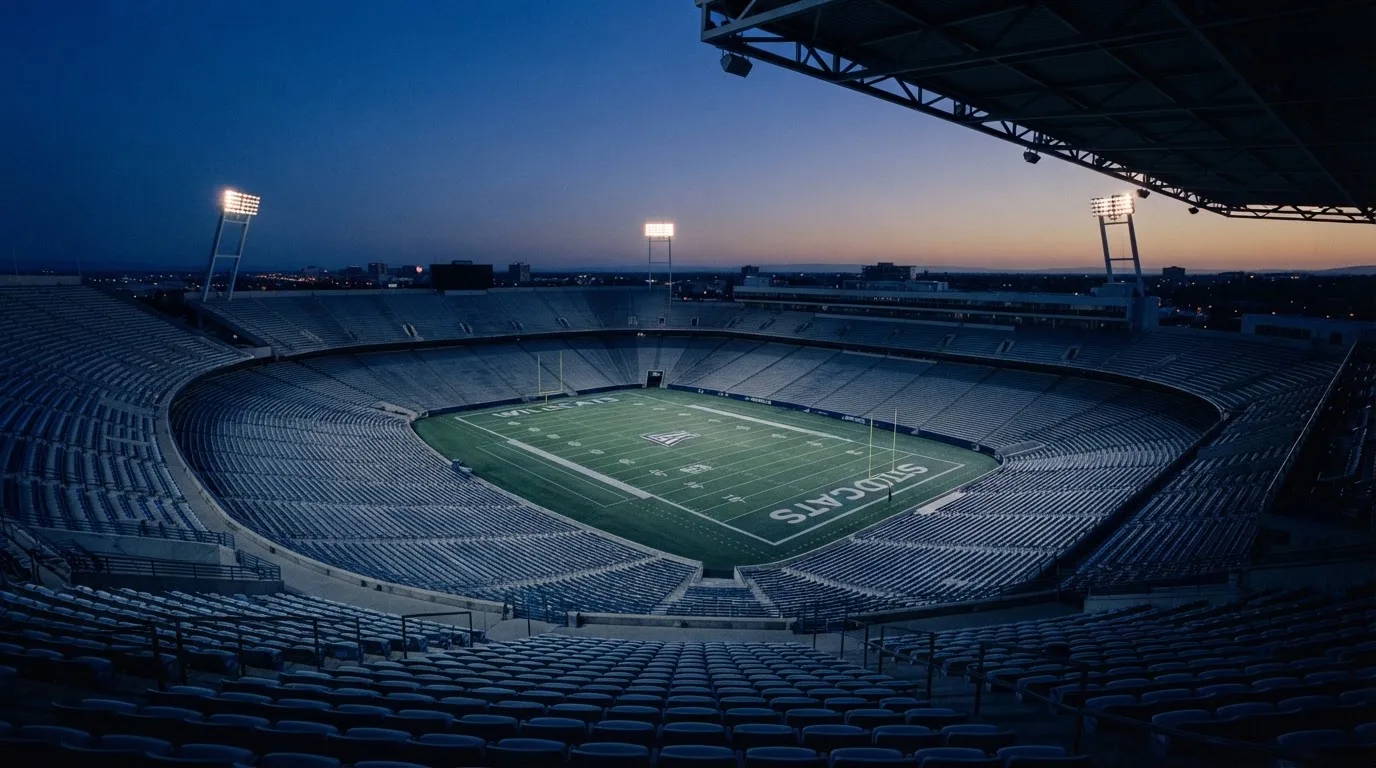
The NFL runs 32 teams, 16 in the AFC and 16 in the NFC. Each plays 17 games across an 18-week regular season, with seven teams per conference reaching the single-elimination playoffs. The Super Bowl for the season just past was played on 8 February 2026 at Levi’s Stadium in Santa Clara; the Seattle Seahawks beat the New England Patriots 29-13, with Kenneth Walker III named MVP. A page about prices for “this year” runs against two calendars at once: the Super Bowl just played and the season coming, and a reader who wants prices on a specific game verifies them in the operator’s own betting programme before staking.
Three scoring notes matter for prices. First, the touchdown carries more weight than a goal in football or a try in rugby, so markets like “first score method” (touchdown, field goal or safety) lean heavily on touchdown frequency, and offers priced as touchdown-only cost the bettor their stake when a kicker hits a three. Second, the two-point conversion is rarer than the extra-point kick but not vanishing; game-state decide whether a coach accepts a certain one-point cost to chase two. Third, the safety produces odd scorelines — 2-0 is theoretically possible but has never happened — and the points spread market is built around lines that anticipate touchdowns rather than the slower arithmetic of soccer. These mechanics are what produces the menu of markets a bookmaker lists: spread, total, moneyline, team total, half and quarter, plus all manner of combinations discussed further down.
Licences, the Register and What a UKGC Logo Is and Isn’t
There is no statutory list of permitted sports, fixtures or markets in Great Britain. The Gambling Act 2005 sets the licensing framework and the Commission regulates under it, but what is offered on any given day is whatever a licensed bookmaker elects to publish within its licence conditions. A bookmaker serving customers in Great Britain needs a Gambling Commission licence wherever its company sits — since the Gambling (Licensing and Advertising) Act 2014 made the point-of-consumption rule law. A Curaçao, Malta or Gibraltar register does not substitute, no matter how prominent the platform.

This is the test for whether a brand is licensed: the Commission’s public register, searchable by business name, trading name, domain or account number. The register is the whole proof. Typing a brand’s name into the search box and reading the entry that comes back is the verification step. The fields confirm three things together — a remote betting licence category such as remote general betting standard (real events), an account number, and a licence-holder company. A payment method, a marketing offer, a jersey sponsorship — none of those is a licence, and a UKGC logo at the bottom of a homepage is a statement of intent, not a substitute for the register lookup. Financial spread betting is the one corner of this market where the regulator is the Financial Conduct Authority rather than the Commission, and the same brand can hold different licences for different products.
Identity verification starts at the front door. Since 7 May 2019 every customer at a GB-licensed remote operator has their name, address and date of birth checked before the first deposit or bet — including when that first bet is free. There is no such thing as an anonymous account at a licensed brand, which is one of the costs of playing in a regulated market, paid by the bettor in a frictional sign-up that unlicensed sites skip. The upside — funds held in segregated accounts, complaints routed to an independent adjudicator, dispute resolution that operators cannot ignore — costs only friction to reach, but friction is real all the same.
The minimum age is 18, set in the Act and not waivable. Anyone featured in a gambling advertisement either is or looks at least 25 — that rule is about marketing imagery and about who may appear in a TV ad, not who is allowed to bet. It is the kind of nuance that matters when a reader sees a gambling logo on a Premier League shirt and wonders whether the rule means under-25s cannot bet: it does not. The shirt is one marketing path; the betting age is settled by the Act at 18.
A point about Northern Ireland: the Gambling Act 2005 covers England, Scotland and Wales. The regulatory question in Northern Ireland runs on a separate, older legal framework — the Betting, Gaming, Lotteries and Amusements (Northern Ireland) Order 1985. Operators serving NI customers either hold a separate licence for that jurisdiction or do not accept them; details on this geography sit outside the main UK-licensed picture here, and the safer framing is “GB-licensed” or “licensed by the Gambling Commission” rather than claiming coverage of all four nations.
Responsible Gambling and the Apparatus Around a Licensed Bet
GAMSTOP is mandatory for every GB-licensed online operator since 31 March 2020. A customer who registers on the GAMSTOP scheme excludes themselves from every online site and app of every GB-licensed operator simultaneously for six months, one year, five years, or five years with auto-renewal. After the chosen minimum the exclusion stays for a further seven years unless the customer takes it off. The exclusion covers online only; betting shops run a separate service under different rules. A reader who self-excludes at one brand is excluded at every brand the register lists, and the operator has no discretion to grant an early return.
That is the headline protection. Around it sit two new mechanisms worth reading carefully. The financial vulnerability check (LCCP condition 3.4.4, in force since 30 August 2024) applies when a customer’s deposits minus withdrawals exceed £150 in any rolling 30 days. It is a public-record check — things like a bankruptcy or a county court judgment — not an income check and not a credit reference. Operators conduct it before accepting further deposits at customers who cross the threshold; the check is automated, the result is binary in practical terms. Financial risk assessments — the so-called “affordability checks” of the press — were announced in a staged plan in July 2026 with no confirmed start date at the point this page was prepared; the newspaper word does not match a live obligation, and a customer who is asked for payslips and bank statements should ask the operator to show the rule requiring them.
Deposit limits are the customer’s tool rather than the house’s. The Commission requires operators to offer a gross deposit limit on a fixed time frame — changes came into force for the first phase on 31 October 2025 and a second phase was postponed to 30 September 2026; the rule the customer sees in the cashier is the live one. Limits are the customer’s decision, set in the operator’s own cashier or by speaking to customer services; the maximum allowed by the operator can be lower than anything the regulator sets, and the minimum is zero.
Help sits outside the betting companies. GamCare runs the National Gambling Helpline. GambleAware funds treatment and education. The NHS operates gambling clinics in several regions. Gamblers Anonymous runs local groups. A customer who finds themselves spending more than they intended, chasing losses or hiding their account from people close to them has a self-test and a first-step call at GamCare before any change at the operator becomes binding. Licensed operators link to these services from their safer-gambling pages; unlicensed operators carry no such links, which is itself a way to read a brand you have not heard of.
What about credit cards? Since 14 April 2020, credit cards are banned for gambling at any GB-licensed operator — including credit-card-funded deposits through an e-wallet. Debit cards, bank transfers and selected e-wallets are not covered by the ban. Crypto assets are not a regulated payment method at a GB operator for the same regulatory reason, though several offshore brands accept them; “bitcoin accepted” is a marker of where the licence sits, not a feature to chase. A reader who wants crypto rails has accepted the trade-off implicit in those last two sentences.
Crypto and Anonymity at American Football Markets
Crypto-native sportsbooks run from Curaçao, Anjouan and a handful of other jurisdictions that issue gaming licences at a different tempo than the Commission. They accept bitcoin, ethereum and stablecoins, settle in those same coins, and have no requirement to verify a name before the first wager. That is the offer. The price, in a regulatory sense: no GAMSTOP coverage, no Commission complaints route, no approved dispute-resolution body that the operator must engage with, and the bettor has no British consumer redress if funds are withheld. A 5% margin is rarely the loosest spread in crypto; the in-house fee is the ceiling and the cash-out is sometimes worse. Crypto rails cost less than a pound-card deposit at the cashier; they cost more if anything goes wrong.
Practical matters for a UK-resident reader. A Crypto sportsbook does not ask for proof of age or address at sign-up, so a UK resident under 18 can in principle open an account; the operator is breaking UK law the moment it accepts a bet from a UK minor at a non-GB licence, and the customer is paying for that feature by being unprotected on every other axis. KYC on withdrawal is the point at which the account slows: the bigger balances tend to trip source-of-funds requests, and the operator’s terms can include “we can close the account and seize balances” wording that a regulated brand is held back from. Treatment of crypto winnings for UK tax purposes is for the reader’s own adviser to handle: the player pays no tax on betting winnings in Great Britain under the General Betting Duty regime, and an offshore crypto win is still subject to whatever tax law it falls under for that reader.
The question of where regulation sits is not a curiosity. The Commission has gone after unlicensed operators offering into Great Britain — cease-and-desist notices, search-engine referrals, registrar and payment-provider coordination, and court-order DNS-blocking powers that were granted or are about to. The current chapter of disruption reaches more brands every quarter, and a brand that accepts bets in USDT this month can be on the regulator’s list next month. State it once: licensed = checks, limits, GAMSTOP, bonus cap, but also verification before the first bet; unlicensed = none of those protections and the loss of funds is real. Neither path is the safe one by default; the licensed path distributes safety back to the bettor.
Bonuses, Free Bets and What an Offer Costs Before It Pays Out
A welcome offer is a marketing cost paid by the operator. Read past the headline number and three things decide what it actually pays. First, the qualifying bet — what you stake, at what minimum price, on what kind of market — gates the bonus. Second, the wagering requirement — how many times the bonus (or the bonus plus the deposit) must be turned over before withdrawal — is the size of the dig. Third, the expiry window and the eligible markets decide whether you can plausibly clear the offer in your own betting week.
Three examples from the bonus wallets of operators the rest of this page covers. Bet365 dangles Super Boosts, Winnings Boosts on Bet Builders and selected singles, and daily Bet Boosts across its programme. Unibet’s welcome states a deposit and a sports bet of £20 or more at minimum odds of 2.0 (1/1), with free bets expiring within 7 days of issue, for new GB customers using a debit card or instant bank transfer. BetTom’s sports welcome returns 50% as a free bet up to £50, with a matched 50% back up to £50 as free slot funds for the casino; full terms apply, and the same wallet does not carry one promotion across both. Swifty Sports lists Best Odds Guaranteed alongside daily price boosts, with Cash Out on horse racing and football markets. None of these is offered as a recommendation to claim; each is described so the reader can compare the structure.
The hard rules that apply across every offer. Wagering requirements on bonuses were capped at 10x as of 19 January 2026, meaning a £10 bonus at 50x needing £500 of bets is no longer available: under the cap, £100 maximum. Mixed-product promotions — an offer that ties betting to casino, bingo or lottery — are banned, so no “bet on football to get free spins” lever at a GB-licensed brand. Free bets whose stake is not paid back with a win are the standard shape at every operator in this comparison; the only question is whether the credit expires in 7 days or 30, and which market types count when you use it. Best Odds Guaranteed on horse racing win and each-way bets from 9am (Fafabet) or 8am (William Hill) on race days is a different mechanism from a bonus: it pays the bigger of the original price or the starting price, and applies to UK and Irish racing, not ante-post, tote or pari-mutuel.
A free bet whose stake is not paid back is worth less than its face. The arithmetic runs cleanly for any price a reader is considering. Take a £10 free bet on a two-way market at decimal odds 2.50: it returns £25 if it wins, the £10 stake is gone, and the net profit is £15. Compare that with a £10 cash stake at the same odds: total return £25, profit £15 in cash. So the free-bet “credit” of £10 produces a £15 win in this example — your free-bet value is the same as a £6 cash stake at the same price. The general rule is that a free bet’s expected value sits at roughly 70% to 80% of its face value at typical prices. An offer that looks 100% on the headline is closer to 70-80% in your pocket, and the operator knows it.
The expected cost of clearing a bonus, where one exists, runs through the wagering requirement and the margin of the market you clear it on. Required turnover at 10x wagering on a £20 bonus is £200 of qualifying bets. At a market margin of 5% that implies an expected cost of £10 to clear the offer, leaving an offer smaller than £10 effectively worthless. A reader who claims a £5 bonus and clears it on 5%-margin markets expects to lose £2.50 of that £5 in margin; a £20 bonus at the same ratio produces an expected cost of £10 and a free-credit value of roughly £10-15 of face value. The model is honest; the marketing message is not.
What the operator’s terms hide. Minimum odds on a qualifying bet (odds of 1.50 is common, evens less so), eligible and ineligible markets (accumulators often, draw-no-bet rarely, virtual sports excluded), cap on free-bet winnings (5x, 10x face values are standard), an expiry in days, a list of deposit methods that do not qualify, and a stake cap during clearing — each is a clause that, in isolation, is small, but the cumulative effect on a “100% up to £100” is often a real-world position that needs £1,000 of bets to clear. Read the terms. The page is not paid to tell you that — your own reading is.
Live Betting, Cash Out and the Markets That Move While the Game Is On
An American football game changes shape from quarter to quarter. A team that opened as a 3.5-point favourite can fall behind 10-0 in the second quarter and the spread swings, sometimes by a full field goal. That is what in-play bets on American football buy, when the match-ups are right: an updated price that reflects clock and score and what the bookmaker’s traders think will happen next. The opportunity is sharp; the cost is a tighter margin on every market inside the game compared to the closing line.
Three operators the rest of this page covers take in-play betting at depth. Betfair Sportsbook runs in-play and a 90 Minute Payout market, free live streaming of UK and Irish horse racing and football, plus a Bet Builder feature on pre-match selections. Bet365 goes wider: in-play, live streaming of events worldwide, Bet Builder+ across one event (pre-match and in-play), and Live Trackers including a Live Golf Tracker that follows ball-by-ball progression; American football carries a live tracker on most fixtures at the brand. Midnite shows in-play events with an acca builder, popular accas and price boosts that carry maximum-stake limits. All three settle in real time, with markets disabled at the relevant whistle or booth review, and odds re-issued after each break.
Cash Out closes a position before the result is final. On a single bet, it returns a fraction of the original return that reflects the current price of the selection. On an accumulator, it does the same across every leg — useful when one leg is at risk and the rest look safe. The price you accept is the price on the spot: bookmakers do not deduct a Cash Out fee by name, but the implied margin in the offered Cash Out is often heavier than the original bet and the difference is part of the cost. Two functions to distinguish: Cash Out lets you settle when the bookmaker offers it; live streaming lets you watch the event so you can decide whether to settle manually. The combination is what a bettor needs to add some control to a position that otherwise only resolves at the end.
Live betting markets available. Moneyline (often with regulation-period prices — first half, first quarter), spread, total points (over/under), race to X points, next score, score after each quarter, plus a set of player-prop markets on passing, rushing and receiving yards. The bigger operators carry a deeper in-play list; the smaller the menu, the more the operator has decided that American football is a pre-match sport for them. A consumer who wants in-play American football every weekend checks the operator’s programme on a Wednesday, since bookmakers trim and add markets to match the slate.
A practical note on suspensions. Bookmakers suspend in-play American football on score-changing plays: touchdowns, field goals, safeties, and a one- or two-point conversion are followed by a price freeze so the trader can re-issue. The freeze lasts seconds; it is not a deliberate delay. The headline “delays” claimed by consumers are usually a few seconds of suspension followed by a re-priced market at odds that reflect the new score. That is what in-play prices do, and a reader comparing brands on responsiveness also wants to compare the platform’s in-play latency.
Predictions markets and tipsters are different beasts. A “tipster” is someone who puts a stake where their forecast is; their record matters more than their tips because forecasting is what the bettor is paying for. Not every price on social media is a tip. Betting models — quantified forecasts — are a different product: a model with a published methodology and a track record at a known sample size. Read the methodology. The page is not in the prediction business because no one can predict the result of an event and any sentence that names a winner becomes the reason the bettor’s stake went missing.
Strategy and the Difference Between a Forecast and a Price
Bankroll management is what keeps a reader playing for years. Three rules of thumb: stake a fixed unit of your bankroll, between 1% and 3%, on any single bet; keep a log of every bet with the price you took and the closing price; and never chase a bad day by increasing stake size. A “system that wins” is a phrase that signals a sales pitch. The system that wins is a system whose average price is better than its average margin across a few hundred bets. That is hard to verify by hand; it is exactly what betting-exchanges let the bettor do without a model, by laying selections at the bookmaker price and tracking whether the betting-exchange back price is bigger or smaller than the betting-exchange lay price the bookmaker was quoting.
Forecasts versus prices. A forecast is a probability statement, a price is a probability statement, and the difference between them is the margin. Take a forecast of 60% on a selection: a fair price would be 1.67 decimal. A bookmaker’s price might be 1.50, the implied probability 67%, and the 7-point gap is the edge the bookmaker takes per unit. A forecasting service that claims 60% for a team but a price of 1.50 is restating the operator’s own probability. The forecasting service owes the bettor a reason why it is better than the price — sometimes it is, more often the operator’s margin has eaten the difference.
The handicap is the bookmaker’s tool to flatten two mismatched teams. A favourite laying 7 points is the team asked to win by more than seven points. An underdog getting 7 points is the team that loses by fewer than seven, or wins outright. Where the handicap is exactly on the result — a 7-point favourite wins 28-21, with the spread landing on 7 — the bet pushes: standard American football rules at the bookmakers in this comparison make the bet void unless a tie is offered as a selection. Pushing on a total (the combined score lands exactly on the over/under line) is the same rule. A reader who works out the bets and the lines at the bigger operators has the cleanest mental model: a handicap is a price on margin, the void outcome is real, and the operator’s empty “tie” market is sometimes a cheaper form of the same bet.
Totals, moneyline and the three-market menu. The moneyline is the outright winner, including overtime for most books; the spread is the handicap; the total is over/under. Three markets on every game, with prices that sum to more than 100% on the implied-probability scale (and the gap is the margin). A reader who works through the menu on Monday for Sunday’s games sees how the bookmakers built their cards. A reader who works it daily sees whether the bookmaker is changing its lines from Saturday to Sunday — sometimes yes, sometimes not.
The single largest source of mistaken bets is the same source across football codes and across US sports: chasing price moves on pre-match markets without an underlying forecast. A line move is information to the operator’s traders, and possibly to you, but a line move without a model is just noise. The model earns its keep because the price change is an arbitrage between the bookmaker’s last quote and the new quote; if you cannot re-state the price change in your own words, the price move is for somebody else.
Bet Types and How to Read What Is on the Slip
Three bet types do most of the heavy lifting on American football: single bets, accumulators, and same-game or Bet Builder combinations. A single is a stake on one selection, settles against the result of that selection. An accumulator ties multiple selections together: all must win for the bet to pay, the odds multiply into one price, and the payout compounds. A Bet Builder takes markets from the same event and combines them into a single bet — Bet365’s Bet Builder+ lets this be built pre-match and worked on in-play. The cost of an accumulator is the higher margin at every leg, compounded into the price; the attraction is the value of a small stake turning into something larger if the bet comes in.
Spread betting is a different market category. Spreadex operates it under a Financial Conduct Authority licence, with statements that losses can exceed the deposit. The mechanics are unlike a fixed-odds bookmaker: the bettor’s gain or loss is the stake multiplied by how many points the result “spread” away from a quoted line, and the loss can be greater than the stake on a strong move. Fixed-odds pricing and spread pricing are not comparable odds; the products look similar on a betting slip but settle differently.
Odds in Great Britain are quoted in fractions by default on UK-facing brands and decimal on international-facing brands, and the same brand often offers both. A 5/1 shot pays 5 times the stake in profit, plus the stake, so a £10 stake at 5/1 returns £60 (£50 profit + £10 stake). The same shot at decimal odds 6.00 returns £60 on a £10 stake. Evens is 1/1 in fractions or 2.00 in decimals. Odds-on means shorter than evens: 4/6 (decimal 1.67) is odds-on. Bookmakers do not round in their own favour; the rounding is in the choice of line. Decimal odds are clearer for punters calculating return; fractional odds are clearer for punters calculating profit. The rule of thumb is the same.
Enhancements and insurance products sit on top of these primitives. A price boost is a single selection or an accumulator where the bookmaker adds a margin of price on top of its own price; the price is more generous than the standard book and the stake limit is correspondingly tighter. Acca insurance refunds a stake as a free bet (not cash) if one leg of an accumulator loses — useful for safer accumulators, less useful for long-priced legs. Best Odds Guaranteed on horse racing pays the bigger of two prices for the same selection; not an enhancement for American football. Each of these has a clause the punter checks before claiming.
A model for reading any bet. State the stake, the odds you took, and the settlement rules: does the bet push on the line, can it void, how is overtime handled, is the player-prop at risk if the named player does not start. The Wagering contribution rule sits in the bonus terms rather than the bet itself: which markets count at 100% to clear a bonus, which at 50%, which are excluded. American football pre-match and in-play singles typically count at 100%; accumulators usually too, sometimes with a minimum-leg rule. Casino-style games contribute nothing and are often banned during clearing entirely. That is the model, with stake, price, rules and contribution.
American Football Markets, Competitions and the Calendar of a Season
The professional calendar runs the NFL regular season from September to January, with playoffs through January and February and Super Bowl at season’s end. Outside the NFL, the CFL (Canadian Football League) plays across summer and fall, with its Grey Cup settling the season in November. College football — the NCAA — runs an August-to-January schedule, with bowl games and the College Football Playoff in December and January. The XFL and USFL re-entered the spring-football calendar in recent years, with shorter seasons and franchises that come and go; prices on those leagues tend to be tight, which is itself a sign that bookmakers know the rosters less well.
Coverage in Great Britain runs through two channels. The bigger operators offer a full menu: moneyline, spread, total, player props for passing/rushing/receiving yards, plus first-half and team-total derivatives, on every NFL game and most NCAA Football Bowl Subdivision games. Smaller operators offer the headline markets only, on a curated slate, with prices that may lag the closing line by an hour. A reader who follows American football for the sake of the games wants a brand with the deeper menu; a reader who follows it once a year for the Super Bowl only needs the headline markets.
Listed competitions vary by operator. Premier league: NFL regular season, NFL playoffs, Super Bowl, Pro Bowl. Second tier: CFL season and Grey Cup; NCAA Football Bowl Subdivision (no playoffs involvement at this brand). Most operators also carry propositional markets on the draft, awards (MVP, Offensive and Defensive Player of the Year, Rookie of the Year) and season win totals ahead of kick-off — these are season-long bets and a “push” rule on total wins is unusual, with bookmakers handling the voidance by settlement rule. A reader who plans ahead looks at those markets in late August and settles them against the line by January.
In-play coverage. Every operator that takes in-play bets in this comparison has a deeper menu on the NFL than any other American football league. The bigger carriers (Betfair Sportsbook, Bet365, Unibet) show markets from first-quarter prices onward. The smaller carriers (Swifty, Spreadex for spread betting) offer the headline markets live with restricted menus. Latency on smaller carriers is often worse, but the menu limit is the bigger issue when a reader wants a quarter or player-prop market to clear live.
News and lines move through the week. Lines open on Sunday after the previous NFL Sunday closes, move through Monday and Tuesday as injury reports shift, tighten by Wednesday and Thursday and reach the closing line on Saturday and Sunday morning. A reader who bet at the opening line paid a heavier margin; a reader who bet at the closing line paid the same margin but on a price that reflects the market. Line shopping — having accounts at two or three operators and comparing each line — costs the bettor nothing and is where the disciplined pocket-book turns: a 0.05 to 0.10 change on the spread carries through to the long-term edge or the long-term loss.
A closing mark on the heart of things: American football is a sport bookmakers understand well, with years of data, traded markets and good closing lines. The reader who wants prices this year gets prices that look and behave like any other sport’s prices — same margin, same mechanics, same Cash Out, same rules. The specifics of touchdowns versus field goals versus safeties are what produced the markets and prices; the basics of how the price is built are the same as for any other sport.
The Bookmakers: How Each One Stacks Up for American Football This Year
A short assessment of each licensed bookmaker the comparison covers. Each is named for what it does best within its own product. These are brands licensed to take remote bets in Great Britain, verified against the public register at the date noted. Pricing and offer details are described from each operator’s own terms, not as a recommendation to claim.
Star Sports — The Phone-Based High-Touch Bookmaker
Star Sports is a UK-facing bookmaker with a long history, with support at the 08000 521 321 trader line and at the [email protected] email address, which is helpful when an account needs human input rather than a chatbot. The proposition leans toward horse racing in Britain, with American football as a more limited menu. Star Sports has built no live-streaming or Bet Builder infrastructure for American football specifically and appears, on its programme, to take the in-play markets only at headline prices. The phone-based service is the contrast with most online competitors and a reason a discretionary punter with a bigger stake prefers to call rather than click. Where Star Sports suits: a higher-stake bettor who values a named trader more than a depth of US-sports markets. It falls short for a reader whose main interest is American football across multiple markets each week.
Bar One Racing — The Irish Independent Rebooked as BAR 1 Betting
Bar One Racing is the old Irish brand now trended as BAR 1 Betting, with shops across Ireland and horse racing sponsorships at Dundalk, Fairyhouse, Navan, The Curragh, Curraheen Park and Cork. The brand is more focused on horse racing than on American football, and a betting programme that covers sports outside horse racing tends to be the headline menu rather than the deeper one. Marketing to GB customers runs on a limited scale, and a UK-licensed remote betting licence sits in the register as the test. Where BAR 1 suits: an Irish-based reader who already has the brand known locally and wants the convenience of a remote account. Where it loses: a UK-resident reader whose primary use is for American football betting.
Fafabet — Horse Racing Best Odds Guaranteed and a Tighter American Football Menu
Fafabet pays Best Odds Guaranteed on UK and Irish horse racing win and each-way bets from 9am on race days, paying the bigger of the original price or the starting price. The terms are typical for the product and the timing is in line with the wider horse-racing market. The American football menu at Fafabet is a curtained version of the leading operators’ offers — a single moneyline, spread, and total, plus a small set of props — and a reader who follows the sport for the menus finds less depth here than at Bet365 or Betfair. Where Fafabet suits: a punter whose American football play is two or three bets a weekend and whose priority is best odds guaranteed on the racing side. Where it loses: a bettor who wants quarter markets, player props and live coverage across every NFL fixture.
BetTom — A Sportsbook With a Casino Tied to the Same Wallet
BetTom’s sports welcome offer returns 50% back as a free bet of up to £50 alongside a matched 50% back up to £50 as free slot funds for the casino. Mixed-product promotions in betting-and-casino form were banned at GB-licensed operators as of 19 January 2026, so any new betting-plus-casino welcome at a GB-licensed brand has to track what is and isn’t allowed. The dossier of BetTom is brief: a single sportsbook running a matched welcome with separate sports and casino wallets. Where BetTom suits: a reader who plays both at the same brand and is happy with the structure. It is a poor match for a reader who keeps the wallets separate and does not want casino funds in any part of the betting welcome.
Fitzwilliam Sports — Capped Membership With Compliance Criteria
Fitzwilliam Sports describes itself as a Dublin bookmaker with capped membership and a “High Stakes Welcome” subject to compliance criteria. The product includes instant deposits, fast withdrawals, timeouts and deposit limits, with links to GambleAware, GamStop and Gamblers Anonymous from the safer gambling pages. Capped membership means the brand is not running an open-ended acquisition push; readers either join during a window or wait for the next intake. Where Fitzwilliam Sports suits: a bettor who is comfortable with a brand that takes its members more selectively and who confirms a US-sports line is live before staking. Where it loses: a casual reader who wants a yes-or-no sign-up by midnight.
Betfair Sportsbook — Exchange Backing, Live Streaming and 90-Minute Payout
Betfair Sportsbook offers in-play betting, Bet Builder for pre-match, free live streaming of events such as UK and Irish horse racing and football within the app, plus a 90 Minute Payout market — a fixed-odds bookmaker under the wider Betfair group, with the exchange as a related but separate product. The American football menu at the Sportsbook is one of the deepest at any GB-licensed brand, and the exchange gives the punter a way to lay positions, particularly around news and team selections. The product range is therefore wider than almost every competitor, but the price may sit heavier on the spread and total than some; the prices a brand shows on a popular event compete with the exchange’s own book. Where Betfair Sportsbook suits: a multi-market bettor on American football who wants the streaming and Bet Builder. Where it loses: a bettor who only ever prices American football and only with the operator that has the lowest margin every week.
Unibet — Established Since 1999 With a £40 Free Bet Welcome and a Deep Sportsbook
Unibet’s UK site runs under Platinum Gaming Limited, Gibraltar, against Gambling Commission account 45322, and states 1999 as its founding year. The sports welcome offer is a deposit and sports bet of £20 or more at minimum odds of 2.0 (1/1), with free bets expiring within 7 days of issue, for new GB customers using a debit card or instant bank transfer. Bet Builder, in-play and live streaming are present on the platform, with an American football programme that covers the headline markets and a respectable live offering. Where Unibet suits: a regular punter who spreads bets across multiple sports, takes a casino-light sportsbook, and reads the terms of the welcome offer. Where it loses: a reader whose primary sport is American football and whose interest is in the deepest in-play menu or the longest-running price boost.
Swifty Sports — Best Odds Guaranteed and Cash Out, With Bet Builder Coming
Swifty Sports offers Best Odds Guaranteed, Cash Out on horse racing and football markets, daily price boosts, live streaming and in-play betting, with Bet Builder listed as coming soon. The American football programme runs the headline markets with a deeper menu on weekends when the NFL slate is at its busiest. Where Swifty Sports suits: a casual reader who wants the staples across horse racing and football, with a developing menu on American football. Where it loses: a serious NFL bettor who needs Bet Builder right now and plans to use it for the rest of the season.
bet365 — The Global Partner With Bet Builder+, Live Trackers and Best Depth
Bet365 is the official global betting partner of the UEFA Champions League and is described as the most downloaded sports betting app in the UK. The product carries Bet Builder+ across one event from pre-match and in-play, Super Boosts, Winnings Boosts on Bet Builders and selected singles, daily Bet Boosts, in-play betting and live streaming of events worldwide, plus Bet Track, Match Live and a Live Golf Tracker to follow bets while they are in play. The American football programme runs from moneyline, spread and total through player props and team totals, with a quarter-level menu in-play on the bigger fixtures and a price-velocity that moves quickly during a touchdown. Where bet365 suits: a regular NFL bettor who follows prop markets, wants live streaming and Bet Builder on the same platform, and who travels away from a desktop. Where it loses: a casual reader whose American football play is one weekend in twenty.
VBet — A £10 Free Bet Welcome on a Losing First Bet
VBet’s sports welcome offer is a £10 free bet if a new and verified customer stakes £10 or more on a first-ever bet that loses. The brand runs under SCGO Limited against Gambling Commission account 44662, and includes VBet Casino on the same brand. A free bet on a losing first bet is the simplest welcome in this comparison: the customer risks a £10 stake, and if it loses, a £10 free bet is credited. Where VBet suits: a brand-curious reader who wants to test a new sportsbook with a low-cost entry. Where it loses: a serious American football bettor whose criteria are depth of market or the highest in-play liquidity.
Licensing Landscape: A Side-by-Side
A clean comparison across the ten bookmakers the rest of this page covers. The licence and the holder of the licence are the two pieces of information a reader checks first; what the operator’s own terms add is the second. The table below uses both, with the licence account number and the licence-holder company from the public register, and a single line on what each operator’s terms state about American football.
| Brand | Gambling Commission licence (account number) | Licence holder |
|---|---|---|
| Star Sports | Remote general betting standard (real events), account 9177 | Star Racing Limited |
| Bar One Racing | Remote general betting standard (real events), account 56516 | Bar-One Racing Limited |
| Fafabet | Remote general betting standard (real events), account 57385 | Taichi Tech Limited |
| BetTom | Remote general betting standard (real events), account 64959 | Bet Tom Limited |
| Fitzwilliam Sports | Remote general betting standard (real events), account 48760 | SBKI Limited |
| Betfair Sportsbook | Remote general betting standard (real events), account 39439 | PPB Counterparty Services Limited |
| Unibet | Remote general betting standard (real events), account 45322 | Platinum Gaming Limited |
| Swifty Sports | Remote general betting standard (real events), account 58957 | Swifty Global (UK) Ltd |
| Bet365 | Remote general betting standard (real events), account 55148 | Hillside (UK Sports) ENC |
| VBet | Remote general betting standard (real events), account 44662 | SCGO Limited |
All ten brands carry a remote general betting standard (real events) licence from the Gambling Commission, which is the standard remote betting licence for a GB-licensed sportsbook. The licence-holder company is the legal entity named on the public register: betting companies may operate multiple brands under one licence, which is why separate platforms can share a single licence holder (for example Ladbrokes and Coral, Paddy Power and Betfair) but cannot merge into one comparison entry. Each is its own brand, its own programme and its own terms, even when one licence-holder sits underneath.
There is one item worth checking in each operator’s own terms before staking on American football: the set of markets they accept. A bigger operator like Betfair Sportsbook lists the deepest US menu in this group; a more concentrated operator like Fitzwilliam Sports or Bar One Betting may carry only the headline markets. That difference is not in the licence table because the licence is the same; the menu is a product decision that is verified by opening the betting programme. Use the licence table to confirm the licence; use the betting programme to confirm the menu. The two checks together are what the reader does in the first ten minutes with any new account.
Margins and the Cost of a Two-Way Market
The bookmaker’s margin is what every line on a betting programme hides. A fair price on a two-way market with odds 1.90 and 1.90 (each the same as 9/10 in fractional form) gives a payout share of 1 / (1/1.90 + 1/1.90) = 1 / (0.5263 + 0.5263) = 1 / 1.0526 = 0.95, or 95%. The margin is therefore 5%. That is the textbook outcome at a normalised price, and the real outcome on American football sits near it for popular two-way markets like spread or total but moves wider on player-prop and quarter markets, where the line is sharper relative to the bookmaker’s confidence. The “around 5%” here is illustrative: the operator’s actual margin on a specific market is whatever the operator states on its own programme, and the spread on a normal Sunday of NFL action ranges from below 3% on the most popular moneylines to over 10% on quarterly totals and player props.
A 5% margin means the operator keeps 5p of every £1 staked on the market. The bettor receives 95p of “fair” odds on every line, on average. That is the figure every advertised price sits below, and the reason two prices at 1.90/1.90 add up to more than 100% on the probability scale — the overround is the margin. A reader using the closing price as a proxy for the true probability recovers the right probability minus the margin. The discipline of price-shopping and line-shopping sits on top of this: the same fair probability priced at 1.85 is a worse bet than the same fair probability priced at 1.95, and the disciplining point is to find the 1.95.
What this means for a reader’s stake. A reader staking 1,000 bets at a margin of 5% across the season expects to lose 5% of total stakes in expected terms, before the impact of line shopping. A reader who can pick the operator that prices NFL at 3% on the spread and Bet Builder markets recovers roughly 2% of stake over a season. That is the dollar value of a margin-monitored programme. The cost shows up in turn, not in any single bet, which is what makes it hard to see: every bet is won or lost on its own outcome, and the margin survives only in the long-run average. The 5% on a £10 weekly stake for 17 weeks is £8.50 of expected loss; a fairer programme at 3% reduces the loss to £5.10, a £3.40 saving. Whether the saving is worth the effort is the reader’s call.
For accumulator betting, the cost multiplies. A three-leg accumulator at 5% margin per leg is priced at 14.3% margin in the round. A five-leg at 5% is 22.6% — over a fifth of every £1 staked is the bookmaker’s cut. A ten-leg at 5% per leg is 40.1% — under 60% of every £1 staked returns to the bettor on average. The long-priced acca is the public face of a sportsbook, not the best-priced bet. A reader chasing one every weekend is paying a tax for the chance of a large payout. The reader’s homework is to know what the price is on the bet.
Frequently Asked Questions
How do I start betting on American football from Great Britain?
Pick a bookmaker from this comparison and verify its Gambling Commission licence at the Commission’s public register (search the brand name, the trading name or the domain). Verify age (18+) and identity at sign-up — name, address and date of birth are checked before the first deposit or bet. Fund the account by debit card, bank transfer or a permitted e-wallet. Credit cards cannot be used. Open the American football programme, find the fixture, choose a market, take a price and stake. The odds are quoted in fractional form by default on UK-facing brands and decimal on others.
What is American football betting, in plain English?
It is wagering money on the outcome of an American football game or on events within it — moneyline (who wins), spread (the handicap), total (over/under the combined score), player props (passing, rushing or receiving yards for a named player), first-half and quarter markets, plus accumulators combining several selections into one price. The bet settles at the end of the game (or sooner when Cash Out is offered), with the payout calculated as stake × decimal odds, in cash for cash bets and as a free-bet credit for free bets whose stake is not paid back with the win.
Where can I find the top American football betting odds?
Compare prices on the same market across several licensed bookmakers before staking. The bigger operators — Bet365, Betfair Sportsbook, Unibet — show the deepest menus and run closer to a 3-5% margin on headline markets; smaller operators sit slightly wider but pay well on horse racing across Best Odds Guaranteed. Line shopping is free and reduces the margin per bet. A line that has moved an hour before kick-off may also have moved away from where the bettor had wanted to be. The registration takes minutes and the verification takes a day or so; a reader who plans for the season builds two or three accounts and compares.
How can I check that a bookmaker holds a Gambling Commission licence?
Open the Commission’s public register. Search by the brand’s business name, trading name, account number or domain. The result lists the licence categories (e.g. remote general betting standard (real events)) and the licence-holder company. If the search returns no result, the brand is not licensed by the Commission. Take the register’s result as the single test: a UKGC logo at the bottom of a homepage is a statement of intent, not proof. The register entry is the proof.
How is the return on a bet calculated from the stake and the odds?
Multiply the stake by the decimal odds. For a £20 stake at 3.50, return = £70 (decimal). At fractional odds 5/2 the same stake returns £20 + £20 × (5/2) = £70. Net profit = return − stake = £50. On a combination bet the odds of each leg multiply into one price, and the same stake × combined odds formula applies. For bets whose stake is not paid back with a win (free bets), net profit is calculated as stake × (odds − 1) — which at odds 3.50 is £50 of profit, with the original £10 stake not returned.
What This Page Is Not Saying
The list of bookmakers above is not a recommendation to sign up, deposit or bet with any of them. The list is verified against the public register; the offers described are the operators’ own terms and are not endorsed as the best available. Bonuses, free bets and price boosts cost the bettor real money to clear and the clearance rate depends on stakes, qualifying prices and eligible markets. A bonus with high headline value and a 10x wagering cap clears honestly; a more aggressive structure is no longer legal at a GB-licensed operator since 19 January 2026.
The pricing discussion uses an illustrative 1.90/1.90 two-way market to explain the margin. Real odds on any given day on any given market vary, sometimes widely, sometimes by movement during the game. A reader who needs the price at this moment opens the betting programme. The closing line on a popular NFL game is faster and tighter than the opening line and is the cleanest proxy for fair probability a bettor can see. The line just before kick-off matters more than the line three hours before.
The tournament calendar above is descriptive. The NFL, CFL, NCAA and the spring leagues all run on different rhythms and to different rules; the betting programme at each bookmaker varies accordingly. A reader who follows the NFL every Sunday in-season will not follow the NCAA every Saturday and the CFL every summer — three programmes, three different menu depths, three different best-priced markets. Build the account list around the competitions the reader actually follows.
The fastest way for a brand to lose the reader is the “guaranteed win” tone. No bookmaker wins every market. The closing line at the bigger bookmakers is a tight estimate of true probability minus 3-5% margin. A punter whose discipline holds the margin at 3-5% on every bet who also line-shops at two or three books can expect to lose less than the average stake-weighted margin across a season. That is the realistic edge. A guaranteed tip is a sales pitch and the sales pitch is paid for by the bettor’s stake when the tip does not win.
US & other team sports – Lowdepositbetting.com
Content created by the «Lowdepositbetting.com» team
